Apple lost its EU appeal. Here's what other mobile stores cost you
Apple's DMA loss and Google's Play catalogue sharing make third-party mobile stores real options. Here are the fees, the defaults and the checks for small teams.
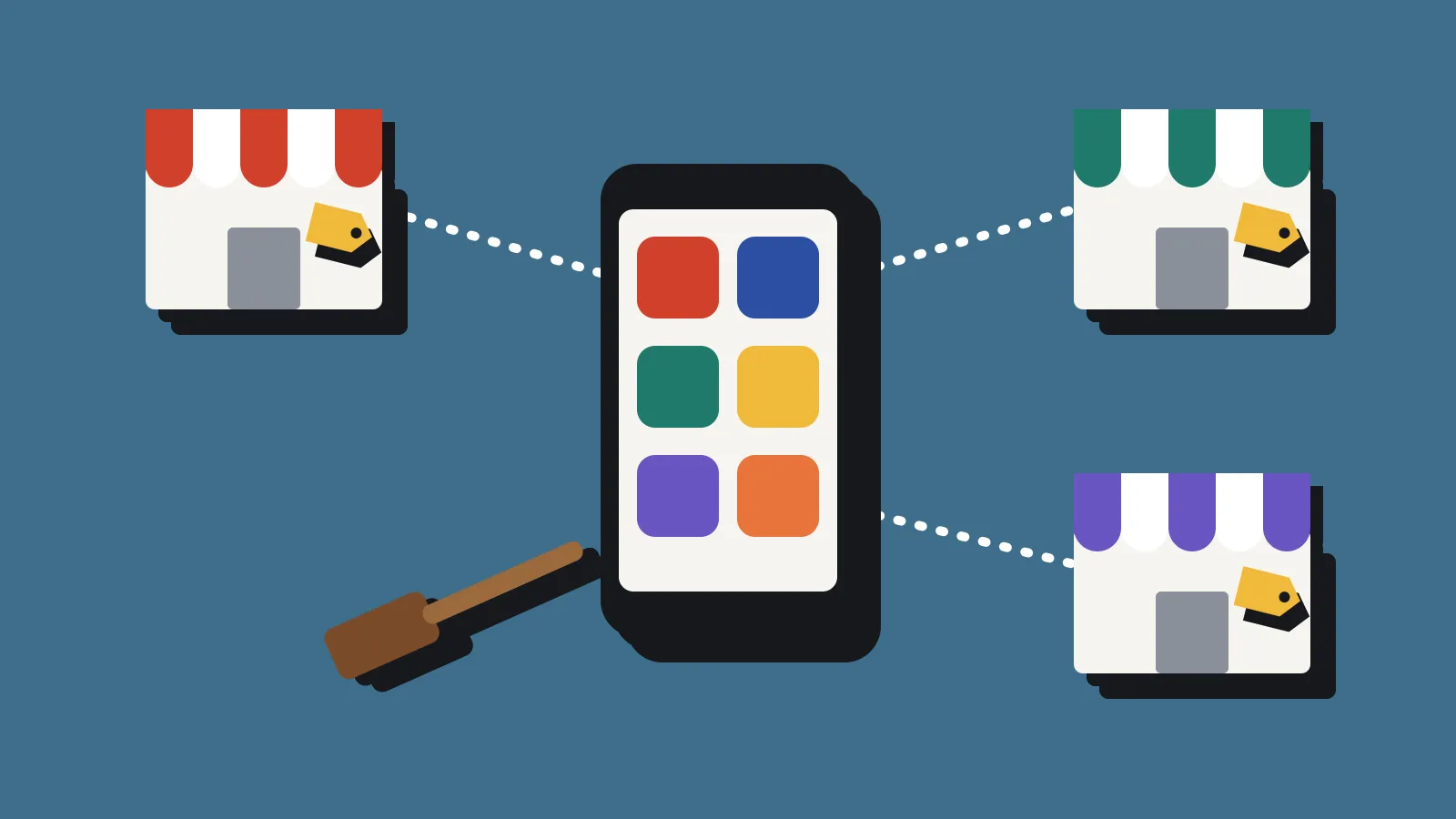
On 8 July 2026, the EU General Court threw out Apple’s challenge to its “gatekeeper” status under the Digital Markets Act (DMA). Two weeks later, on 22 July, Google Play in the US started handing its app listings to rival Android stores. Together, they mean a solo mobile dev can now sell outside the two big storefronts in the EU and the US without rebuilding their store page from scratch. An 80 Level opinion piece published on 7 November argues small studios are among the quickest to try it. Before you do, here’s what each route costs and what it asks of you.
What the court decided
Apple had argued that its App Store was really five stores (iPhone, iPad, Mac, Watch and TV), each too small to count as a gatekeeper. The General Court disagreed. It found they all do the same job of connecting developers with users, so they count as one service. The ruling covers joined cases T-1079/23 and T-1080/23, plus T-214/24. Apple can appeal to the Court of Justice, but only on points of law. A law firm’s review in late August found no appeal on record at that point.
So the DMA rules that let iPhone users in the EU install apps from other marketplaces, or straight from a developer’s website, stay in place. Apple’s separate appeal on interoperability is still pending.
Apple’s EU terms, by route
Apple’s developer page lists new unified terms that took effect on 1 October 2026. They replace the old store services fee tiers and drop the initial acquisition fee. In short:
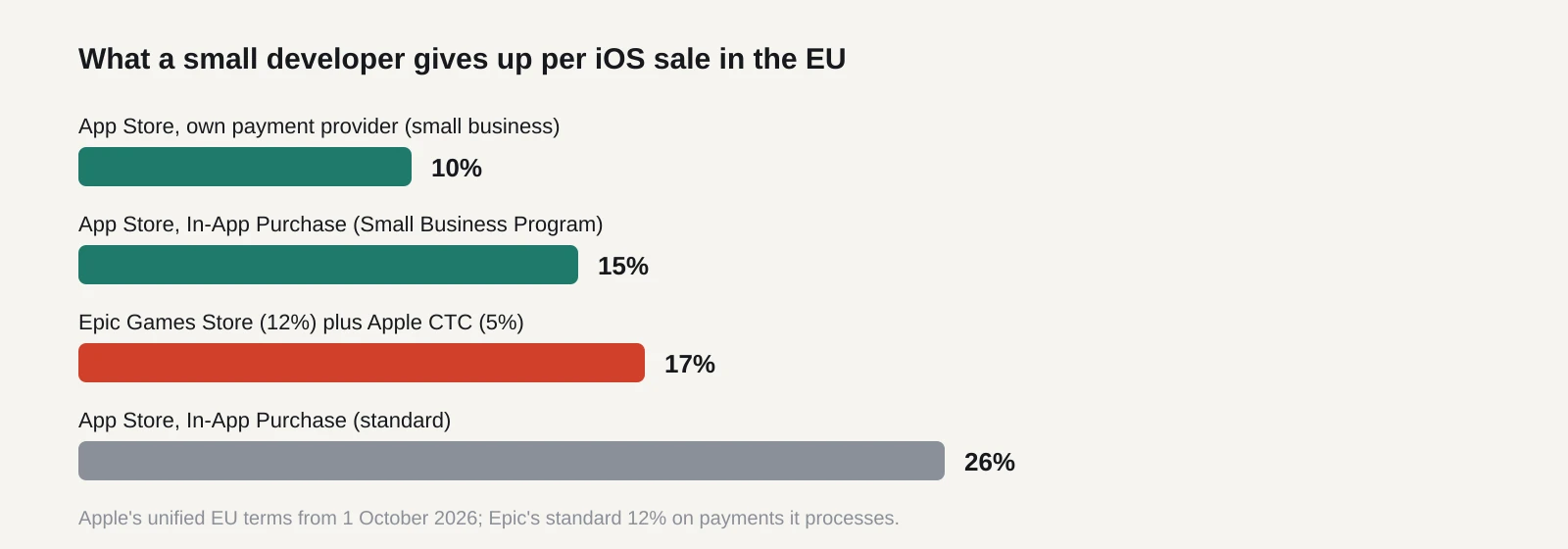
- App Store with Apple’s In-App Purchase: 26% commission, or 15% if you’re in the Small Business Program (and for subscriptions after year one).
- App Store with your own payment provider in the app: 20%, or 10% for small businesses.
- App Store with a link to an outside offer: a 15% store services commission, or 10% for small businesses, on sales made within seven days of the link tap.
- Alternative marketplace or your own website: a 5% Core Technology Commission (CTC) on digital sales. The old €0.50 per-install Core Technology Fee is gone.
Every iOS app still has to be notarised, whatever route it takes. Notarisation is Apple’s review for safety, security and privacy, with automated checks and a human reviewer. You pick alternative distribution in App Store Connect when you submit.
Web distribution has a higher bar. You need Apple’s authorisation and at least one of these: a moderate Dun & Bradstreet financial score, a public listing, venture funding, an accountant’s audit, approved non-profit or education status, a US$1 million stand-by letter of credit, or one million first annual installs. Most solo devs won’t meet any of those. That leaves a marketplace such as AltStore PAL or the Epic Games Store on iOS as the realistic option outside the App Store. Epic has taken third-party mobile games on iOS in the EU since January 2025, and its standard cut is 12% on payments it processes.
Google’s catalogue sharing in the US
Google’s change came out of the Epic v Google court order. Under the Play Catalog Access Program, enrolled US stores can show your Play listing (name, icon, description, screenshots and video) in their own catalogue. When someone installs your game from a rival store, the download still runs through Google Play on normal Play terms, and Play’s service fee still applies.
Sharing is on by default. If you did nothing, your listings have been available to enrolled stores since 22 July. You can change that in Play Console under Manage account, Play apps settings, General settings, Third-party app stores. You can share with every store, choose store by store, or opt out.
Rival stores pay Google US$5,000 up front and US$5,000 a year to take part. Developers don’t pay anything to be listed. RevenueCat’s write-up found Aptoide Games was the only enrolled store visible so far. The court’s remedies run for three years, ending on 1 November 2027.
What it means for a solo dev or small team
On Android in the US, very little changes for you. You get extra shop windows at no cost, but the billing and the fee are Google’s, so you won’t make more per sale. It’s free reach, if players actually browse those stores.
On iOS in the EU, the maths is different. A marketplace sale carries Apple’s 5% CTC plus whatever the marketplace charges. On the Epic Games Store that’s 5% plus 12%, or 17% in total. Compare that with 15% on the App Store under the Small Business Program. So for a small developer, the App Store can be the cheaper option per sale. A marketplace only wins if its cut is under 10%, or if it brings you players you wouldn’t reach otherwise. Reach is the other problem. Most players still search the App Store first, and a marketplace listing sits outside Apple’s own search and charts. Setapp Mobile, one of the early EU marketplaces, closed in February 2026, which shows these stores can disappear.
The 80 Level piece argues mid-size studios are holding back while indies and large publishers move first. That fits the economics. A solo dev with a small game risks very little by adding a listing, and a big publisher has the audience to pull players across.
What to do now
- Check your Play Console setting. Go to the Third-party app stores page and decide on purpose. If your game targets kids or has strict age ratings, review each store’s own policies before you share with it, because Play’s content rules don’t apply there.
- Join Apple’s Small Business Program if you haven’t. At 15%, it can beat a marketplace’s fee plus the 5% CTC. Epic’s 12% plus 5% comes to 17%.
- Price a marketplace listing properly. Add Apple’s 5% CTC to the marketplace’s own cut, then compare that with what you keep on the App Store. Look at the marketplace’s audience size too, not only its fee.
- Keep the App Store listing. An alternative store is an extra channel. Apple requires notarisation either way, so a second listing adds little technical work, but your App Store page is still where most players will find you.
- Watch the dates. Apple can still appeal on points of law, and Google’s obligations end on 1 November 2027. Don’t build a launch plan that needs either to last forever.
We’ll update this piece if Apple takes the case to the Court of Justice, or if more stores join Google’s programme.
Sources
- Update on apps distributed in the European Union (Apple Developer)
- Press release No 96/26, 8 July 2026 (General Court of the EU)
- Apple overhauls App Store fees in the EU with new unified terms (9to5Mac)
- Revenue share (Epic Games Store)
- Epic Games Store will finally launch third-party mobile games (VentureBeat)
- Google is ordered to open Android Play Store for three years (Thurrott)
- Third-party app stores and your listings (Google Play Console Help)
- Apple loses challenge over EU app store rules (Euronews)
- Google will allow third-party app stores on Android (Engadget)
- Third-party Android app stores in the US (RevenueCat)
- Mobile game gatekeepers are opening the gates (80 Level)