Unity and PvX will fund your ads. Check if you qualify first
Unity and PvX now offer ad money repaid from player revenue instead of equity. It suits mobile games already spending heavily on ads, not most indies.

On 27 October 2026, Unity and PvX Partners announced a deal to fund user acquisition (UA) campaigns for studios that make games with Unity. UA is the paid advertising that brings new players to a game, mostly on mobile. The money comes from PvX, studios don’t give up any equity, and repayment is tied to how the players you buy actually spend. Neither company has published the cost, the repayment terms or who qualifies. So before you get excited, here is what we know, and what to ask.
What Unity and PvX are offering
PvX is a UA financing company. It says it has committed more than US$1.3 billion so far across 17 markets. Its money comes partly from General Catalyst, a large venture firm, through that firm’s Customer Value Fund.
Under the new deal, studios that pass a review by PvX get a few things:
- financing for their ad campaigns from PvX
- a credit to spend on Unity Ads (the amount isn’t stated)
- better customer support from Unity
- a chance at more generous invoicing terms from Unity
In return, studios join Unity’s Developer Data Framework. Neither company has said in public what data that shares. Unity also pitches the deal alongside Unity Vector, its ad targeting system. PvX’s chief executive credited Vector with improving returns for customers.
The announcement doesn’t give a programme name, an application form or any fees. It points readers to PvX’s own site for more detail.
How cohort financing works
PvX calls its model cohort financing. A cohort is the group of players you acquired in a given month. PvX’s guide to the model, published in April 2026, explains the basics.
PvX looks at your past cohorts and sets a limit. Each month, it can pay up to 80% of that month’s ad spend. You then repay that cohort’s share out of the revenue those players generate. Repayment follows your ROAS curve, which tracks how much of your ad spend you’ve earned back over time. It stops when that cohort reaches 100% ROAS, meaning it has paid back what it cost.
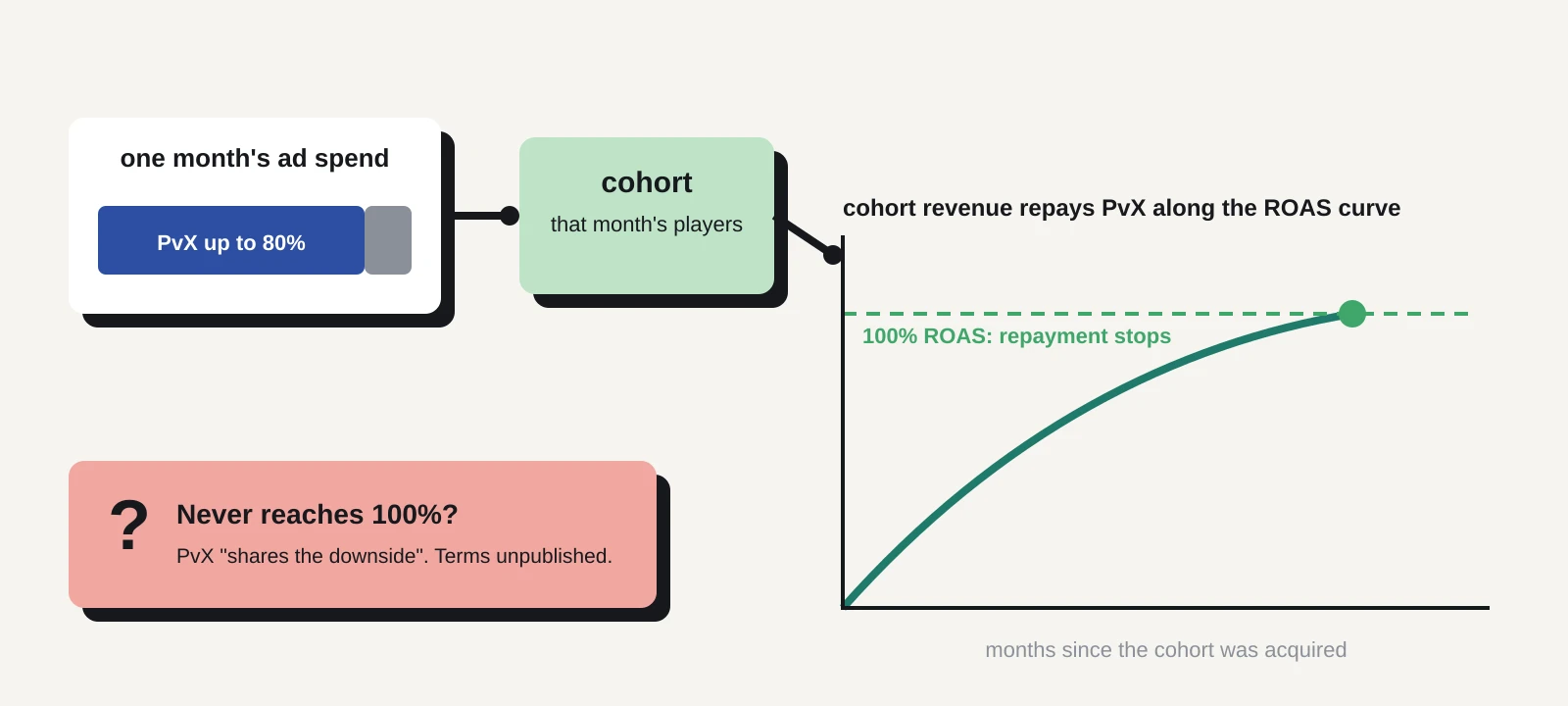
PvX says it shares the downside when a cohort performs badly. Its public material doesn’t say how much of the loss it carries. It also doesn’t say what happens to a balance that never gets paid back. That is the detail that matters most, and you’ll only find it in the contract.
Standard revenue-based financing is a loan repaid as a fixed share of all your revenue. Cohort financing differs because each month’s spend is repaid only from the players that spend bought. If it works as described, a bad month of ads shouldn’t drag down your whole business. That makes it less risky than putting UA on a credit card or a personal loan.
Who it’s really for
PvX’s guide lists what a strong applicant looks like:
- about six months of cohort history
- ad spend of around US$100,000 a month
- ROAS curves that pay back in a predictable way
- clean attribution data from a mobile measurement partner (MMP), the service that tracks which ad brought in which player
- recent cohorts that look like older ones that paid back
PvX describes the US$100,000 figure as typical of strong candidates, not a hard minimum. Even so, it rules out most of our readers. A solo dev spending A$2,000 a month on ads for a premium Steam game is nowhere near this. Unity’s own announcement says the deal is for “growth-stage” studios.
The model also assumes a game where players keep spending after install. Free-to-play mobile games with in-app purchases or ads fit that well. A premium PC game earns most of its money in the first weeks, then sales fall away. You can’t easily model that as a ROAS curve, so it’s hard to finance this way.
There is one useful lesson for everyone, though. The data PvX wants is the same data you need to know whether your ads work at all. If you can’t say what a player costs you and what they earn back, no lender can either.
What to ask before you sign anything
If your game does fit, treat this like any other loan. Get the full terms in writing and ask about these points.
- Total cost. Ask for the fee or return PvX takes, written as one number, such as an effective annual rate. Pollen VC, another UA lender, offers calculators that turn its products into a simple interest rate. Ask PvX for the same figure.
- Recourse. Find out what happens if a cohort never reaches 100% ROAS. Does the unpaid amount become a debt you owe, or does PvX write it off?
- Security. Ask what the deal is secured against. Some lenders take a claim on your app store revenue. Find out whether they get first call on your income before you pay yourself or your team.
- Data and lock-in. Ask exactly what the Developer Data Framework shares, and with whom. Check whether the deal requires you to spend with Unity Ads, or limits which other ad networks you can use.
- Exit. Ask how you leave, and what you owe if you stop spending or sell the game.
Then compare it with the alternatives. If your problem is the 30 to 60 day wait for app store payouts, a revenue advance from a lender like Pollen VC may cost less. If you need money for development, look at publishers, grants or regional funds instead. UA financing only pays for ads.
What to do now
If you’re not spending on ads yet, you can ignore this deal for now. Instead, set up the tracking that would let you use it later. Tag your store links, track cost per install, and keep a monthly sheet of what each month’s players earned. Our earlier piece on wishlists covers a similar point for Steam: measure what each step is worth before you spend on it.
If you are spending on mobile UA and your cohorts pay back, contact PvX and ask for written terms. PvX also runs Lambda, a free benchmarking tool that compares your cohorts with more than 5,000 others. That will tell you whether it’s worth applying, without signing anything.
Sources
- Unity and PvX launch partnership to expand access to user acquisition financing for game developers (Unity)
- Essential UA financing guide, April 2026 PDF (PvX Partners)
- Unity partners with PvX to offer funding for game developers (PocketGamer.biz)
- Unity partners with PvX to offer UA financing to mobile studios (MobileGamer.biz)
- PvX crosses $250m in committed UA financing, December 2025 (PocketGamer.biz)
- Selecting a UA financing partner (Pollen VC)