Steam reviews now take up to 12 business days. Plan for it
Valve says store page and build reviews are running well past the usual three to five days. Here's how to move your launch timeline and avoid a failed review.

Valve says Steam’s pre-release reviews are now taking up to 12 business days. Its usual target is three to five. The company explained the delay in a Steamworks post on 3 November, titled Updates to the Pre-Release Review Process. If your launch date is less than a month away and Valve hasn’t approved your build yet, check your timeline today.
What Valve said
According to Game Developer’s report, Valve put the delay down to a big rise in store page and build submissions over recent months. Submissions around October’s Steam Next Fest doubled the previous record. Valve didn’t blame AI-made games, though plenty of developers have.
A large share of the extra time comes from re-reviews. These are games that failed the first time and came back for another look. Valve shared tips for passing first time and said more process changes are coming. It hasn’t said what they are yet.
Developers are feeling it. Kotaku reported that some waited two to three weeks with no word from Valve. Others said a rejection was followed by another month or more before the second review. Game Dev Report’s Code Monkey wrote on 8 November that he was waiting on a build review before a planned 12 November launch.
How Steam review works
Every new game on Steam goes through two reviews before release. Valve’s review process page sets out what each one checks.
- Store page review checks that your page only describes features and content that will be there at launch. It also checks that the capsule art is readable, the screenshots show real gameplay and the description is clear.
- Build review checks that the game starts on every operating system your page lists, that every listed feature works and that in-game purchases go through the Steam Wallet.
Both normally take three to five business days. Valve already asks you to submit at least seven business days before you need a result. Early Access games also need answers to Valve’s Early Access questions, and adult-only games can take longer.
There’s a separate rule that catches people out. Your store page must be public as Coming Soon for at least two weeks before release, according to Valve’s release requirements. So the store page review has to finish well before that two-week window starts.
What it means for a solo dev
Most small teams pick a launch date, tell their followers and work backwards. That plan assumes a three to five day review. At 12 business days, each review takes about two and a half calendar weeks. A single failure and resubmission can push that past five weeks.
For a solo developer that’s a real cost. A slipped date can clash with a sale, a festival or a bigger release you planned around. It can also land in the same week as press coverage you lined up. Delays are worst after a failure, so the cheapest fix is to pass first time.
The most common failures are mismatches between the store page and the build. Game Developer pointed to one example. Wheel Make It failed because reviewers couldn’t start local co-op, which its store page listed. The developer says the mode works with two players on one keyboard, but the reviewer didn’t find it. If a feature is easy to miss, the reviewer may miss it.
What to do now
Here is a timeline that allows for the current delays and one failed review.
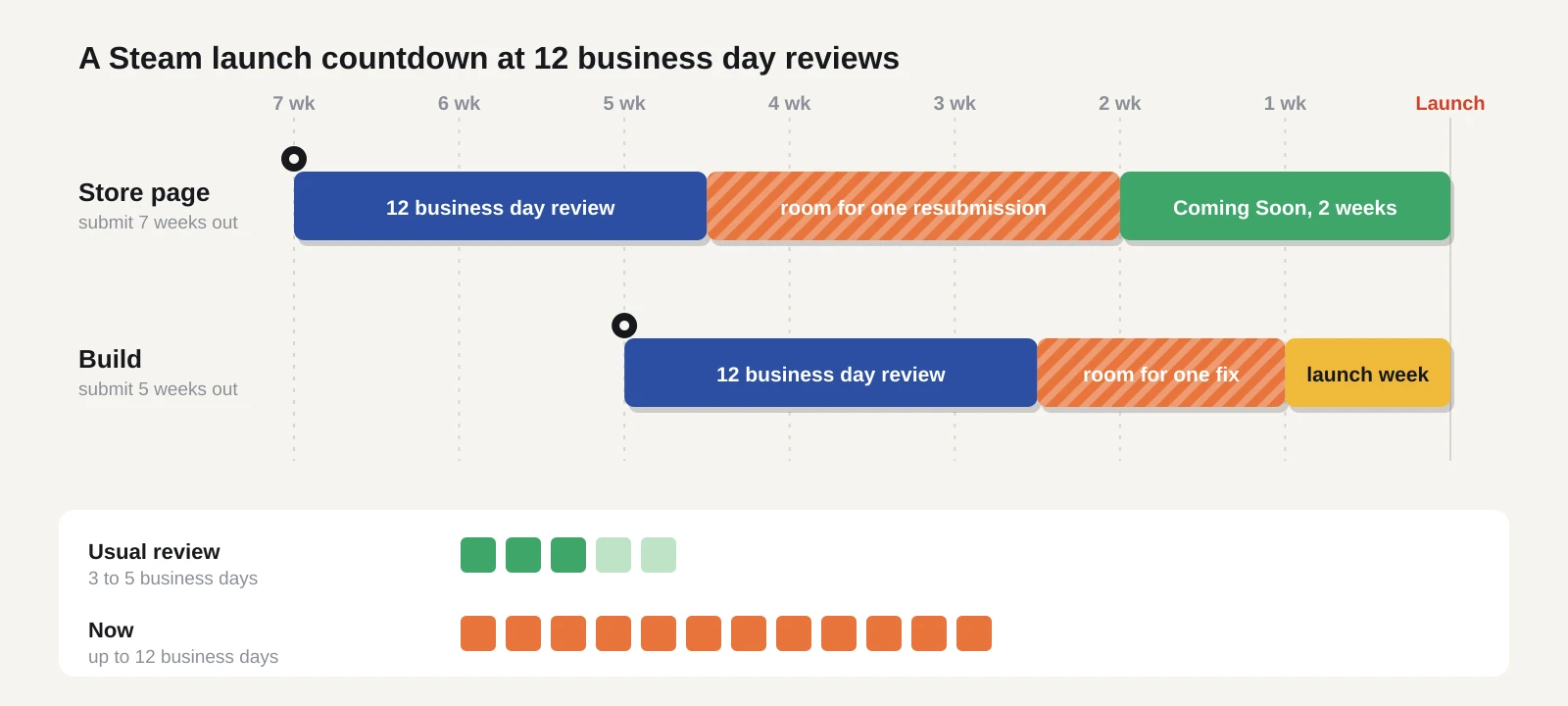
- Store page: submit at least seven weeks before launch. That covers a 12 business day review, a possible resubmission and the two-week Coming Soon period.
- Build: submit at least five weeks before launch. Send a build that’s close to final. Valve says you don’t need another review to update an approved game, so later patches won’t slow you down.
- Don’t announce a firm date until the build is approved. Say “this winter” or “early next year” until then. It’s easier than walking a date back.
- Match the page to the build, line by line. For each feature on the page, check that a stranger could find it in the first few minutes. Explain anything unusual, like shared-keyboard co-op, in the review notes and in the game.
- Test every operating system you list. If you list macOS or Linux, launch the actual Steam build on each. If you can’t test one, drop it from the page until you can.
- Check your screenshots and capsule. Gameplay only, no concept art, and a capsule that reads at small sizes.
- If you’re already waiting, don’t resubmit to jump the queue. Answer any feedback in full in one go. Partial fixes lead to another round.
Here’s how that looks for a game aiming at Thursday 21 January 2027. Submit the store page by early December. Allow for the holiday break, when reviews may slow further. Aim to have the page live as Coming Soon by the first week of January at the latest. Submit the build by mid December. That still leaves room for one failed review and a fix before the launch week.
If those dates already look tight, it’s better to move the launch now than in the middle of January. A date you pick yourself in November costs less than one Steam picks for you later.
If you’re mid-campaign with a date already announced, tell your followers early if it might slip. Players are used to Steam delays this month, and a clear post goes down better than a quiet postponement. Our pieces on falling wishlist value and why your Early Access launch is your real launch cover what’s at stake on launch week.
We’ll update this piece when Valve says what the promised process changes are.
Sources
- Updates to the Pre-Release Review Process (Steamworks Development on Steam News)
- Review process (Steamworks documentation)
- Release requirements (Steamworks documentation)
- Valve warns of slower Steam approvals (Game Developer)
- Devs are being forced to delay their games on Steam (Kotaku)
- Wheel Make It developer’s post (X)