The EU wants loot boxes and pay-to-win off limits to under-18s
The Digital Fairness Act proposal would ban paid loot boxes and pay-to-win for minors, and make games show real prices for virtual currency.
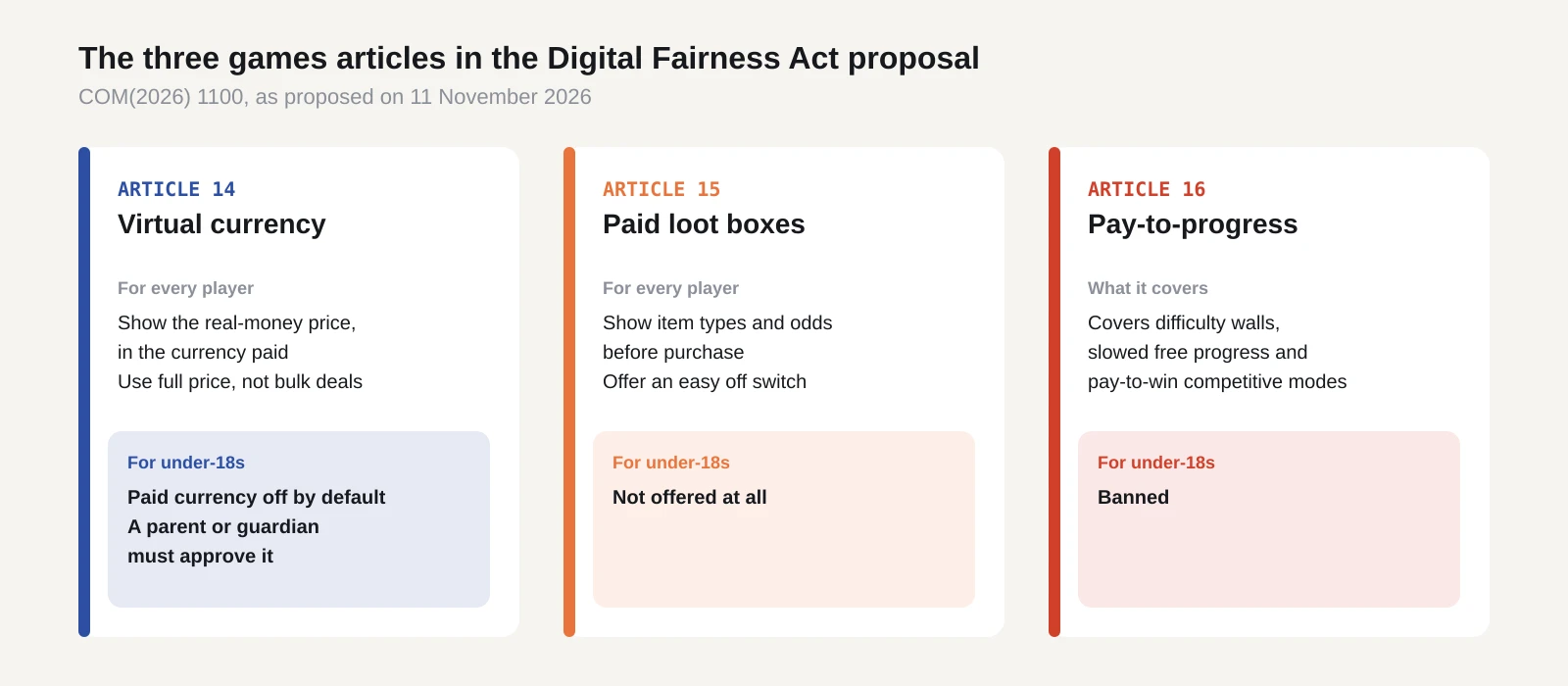
On 11 November the European Commission put forward its Digital Fairness Act (DFA), proposal COM(2026) 1100. Three articles hit games directly. Article 14 makes virtual currency show its real price. Article 15 sets rules for loot boxes. Article 16 bans pay-to-win for players under 18.
It’s still a proposal. The European Parliament and the Council of the EU have to agree it, and coverage of the draft says it would apply 12 months after it enters into force. That gives you time, but design decisions you make this year will still be live in your game when it lands.
What the proposal says about games
Virtual currency. Any currency players buy with real money would have to show its real-world value clearly, in the currency they paid with. If the value can’t be worked out directly, you estimate it from the full price, ignoring bulk discounts and promotions. Loyalty points don’t count. In games aimed at minors, paid currency would be switched off by default, and a parent or guardian would have to approve it.
Loot boxes. The proposal calls them “paid variable reward systems”: random rewards bought with money or with paid currency. That covers loot boxes, prize wheels and card packs. For every player, you’d have to show the item types and the odds before purchase, and offer an easy way to switch these systems off. For minors, you couldn’t offer them at all. Random drops that nobody pays for aren’t covered.
Pay-to-progress. These are purchases that are needed, or presented as needed, to progress or win. The draft’s examples include artificial difficulty walls, progress so slow that the free path is an illusion, and competitive modes where spending decides the result. These would be off limits for minors.
The DFA also lists manipulative design tricks it would ban for everyone. Euronews reported ten from a leaked draft. They include making cancelling harder than signing up, pre-selecting extras, repeated scarcity warnings at checkout, and nagging people to reverse a choice they’ve already made.
Who counts as a minor
Anyone under 18. The rules bite when a game is aimed at minors, or when you’re “reasonably certain” minors play it. The recitals list the signals: an age rating such as PEGI, account data that shows a player’s age, and marketing that appeals to young people through characters, themes, music or language. You wouldn’t have to collect extra personal data to make the call.
That test is the open question. The German games association, game, warned that treating every game rated below 18 as a children’s product would clash with the PEGI and USK systems. Its managing director, Felix Falk, also called the pay-to-progress wording vague. A PEGI 7 cosy farming game with cute animals would very likely meet the test. A PEGI 16 tactics game might not, but the draft doesn’t draw that line for you.
Small studios aren’t exempt
We didn’t find an exemption for small businesses in the text. Recital 88 says players get the same protection whoever sells to them, though authorities should weigh a trader’s size and finances when setting penalties.
The largest fines, up to 6% of worldwide annual turnover, are for cross-border cases the Commission investigates itself. Those cases can’t involve small or medium-sized businesses. National regulators would set maximum fines of at least 4% of turnover for widespread breaches.
The rules cover anyone selling to EU players, wherever they’re based. If you’re in Australia, the US or the UK and you sell in-game items to players in Europe, plan as if this applies to you.
What it means for a solo dev
If you sell a premium game with no in-game purchases, very little changes. Check your store page and any subscription or season pass flow against the banned design tricks, and you’re mostly done.
If you run a free-to-play or mobile game with a currency, a gacha system or random cosmetic crates, this is a design question now. Removing a loot box from a live game is hard. Players have bought into it, your economy depends on it, and your revenue model may too. Building a cleaner system from the start is far cheaper than ripping one out in 2028.
A plain cosmetics shop, where players see the item and its price and buy exactly that, isn’t touched by the loot box rules. If the shop sells in a paid currency, you’d still have to show the real-money value next to each price. Battle passes sit in a grey area. A pass with fixed rewards looks fine. One that sells tier skips to beat a timer may start to look like pay-to-progress, depending on how the final text defines it.
If your game appeals to younger players, the minors rules decide your monetisation. The safest route is a model with no paid randomness, no paid shortcuts and currency that a parent switches on.
What to do now
- List every paid mechanic in your game: currencies, random rewards, boosters, energy timers and paid skips.
- Show the real-money price next to every virtual currency price. It’s a small UI job if you do it early.
- Publish drop odds for anything random that players pay for. Apple and Google already require odds for loot boxes on their stores, so you may have this already.
- Add a setting that turns off paid random rewards.
- Check your age rating and your marketing art. If either points to under-18 players, plan a minors mode with no paid loot boxes, no pay-to-win and currency off by default.
- For new projects, prefer direct-purchase cosmetics over random ones.
- Watch the Parliament amendments. The minors test and the pay-to-progress definition are the parts most likely to change, and we’ll follow them.
Sources
- Proposal for a Digital Fairness Act, COM(2026) 1100 (European Commission)
- Commission press release on the Digital Fairness Act (European Commission)
- Questions and answers on the Digital Fairness Act (European Commission)
- European Commission proposes ban on paid loot boxes and pay-to-win for minors (Inven Global)
- German games association warns of double regulation (GameDev.net via GamesIndustry.biz)
- EU Digital Fairness Act would tighten rules on loot boxes (iGaming Business)
- European Commission proposes loot box and virtual currency rules (Gaming.net)
- EU to blacklist ten manipulative online design traps (Euronews)