Getty Images is in bankruptcy. What happens to your licences?
Getty filed for Chapter 11 on 21 October and says customers won't notice. Here's what your stock licences actually promise, and the records worth keeping.
Getty Images filed for Chapter 11 bankruptcy in Delaware on 21 October 2026. The company owns iStock and Unsplash too, so if you’ve ever grabbed a reference photo, a texture source or a store page background from any of the three, you have a stake in this. The short version: your existing royalty-free licences should be fine. The longer version is a good excuse to tidy how you track licences for everything you buy.
What Getty filed, and why
The filing is a prepackaged Chapter 11, which means the company agreed the restructuring with its main lenders and investors before going to court. Octus reports that a restructuring support agreement dated 12 October already has backing from those groups. The case number is 26-11643.
The numbers are large but vague. Court papers put both assets and liabilities somewhere between US$1 billion and US$10 billion. Members of the Getty family and affiliates of Koch Equity Development have committed up to US$533 million in new equity, and Koch affiliates are adding up to US$143 million in financing. When it’s done, those investors will own 100% of the company, and Getty will leave the stock market as a private business. It expects to finish by the end of 2026.
The filing follows the collapse of Getty’s planned merger with Shutterstock, announced in January 2025 and dropped this year. 80 Level and Reuters both point to heavy debt and competition from AI-generated images as the background.
Getty’s own line is that the filing changes nothing for customers, contributors, partners or staff. Chief executive Craig Peters called it a procedural step to carry out a restructuring the company had already announced.
What your licence actually says
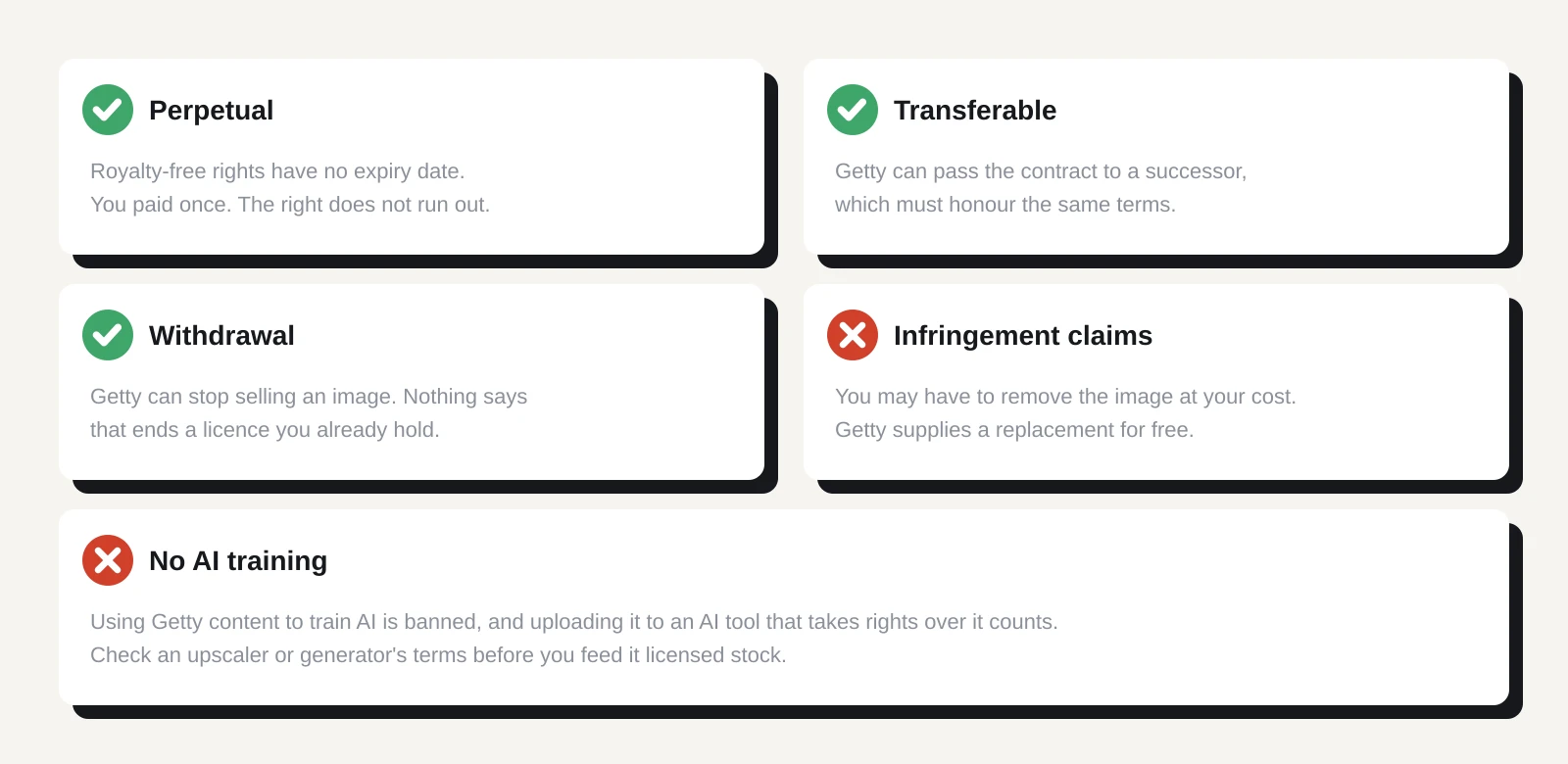
Most indie developers buy royalty-free images, and that’s the good news. Getty’s content licence agreement describes royalty-free rights as perpetual, with no expiry date. You paid once, and the right to use that image in the way the licence allows doesn’t run out.
The agreement also lets Getty hand the contract to a successor or affiliate without asking you, as long as the new owner agrees to be bound by the same terms. That’s the clause that matters in a restructuring. If the business changes hands or shape, your licence goes with it.
Three other clauses are worth knowing, bankruptcy or not.
First, Getty can stop selling any image at any time. That stops new sales, and nothing in the agreement says it ends licences you already hold.
Second, if a third party claims an image infringes their rights, Getty can ask you to stop using it and delete your copies, at your cost. It will give you a replacement image for free. On a shipped game, “at your cost” could mean a patch.
Third, the agreement bans using Getty content to train AI, and its definition of training is broad. Uploading a licensed image to a third-party AI tool that takes rights over it counts. If you run reference photos through an image generator or an upscaler with loose terms, check that tool’s terms first.
Unsplash works differently. Its photos use the Unsplash Licence, which allows free commercial use without attribution but bans selling unaltered copies or using the photos to build a rival service. Getty bought Unsplash in March 2021, and it still runs as its own brand.
We aren’t lawyers, and this isn’t legal advice. If your game depends heavily on one vendor’s content, a short consult is cheap insurance.
What it means for a solo dev or small team
For most of you, nothing changes this week. Downloads, accounts and existing licences should carry on as normal, and Getty has every reason to keep customers calm while it finishes the process.
The bigger lesson is about every store you buy from. Fab, the Unity Asset Store, itch.io and the smaller marketplaces can all change owners, change terms or shut down. Fab itself replaced the Unreal Marketplace, ArtStation Marketplace and Sketchfab Store in 2024. When a store changes, the proof that you bought something under certain terms often lives only in your account on that store. If the account or the store goes away, so does your easy proof.
Licence questions also tend to arrive at the worst time: during a publisher’s due diligence, a platform’s content review, or a takedown request a week before launch. Records you made at purchase time answer them in minutes. Records you have to rebuild from old emails take days.
What to do now
Pull your licence history from any Getty, iStock or Unsplash+ account you use, and save it outside the account. Getty lets you download licence details from your account; save them as PDFs with your project files.
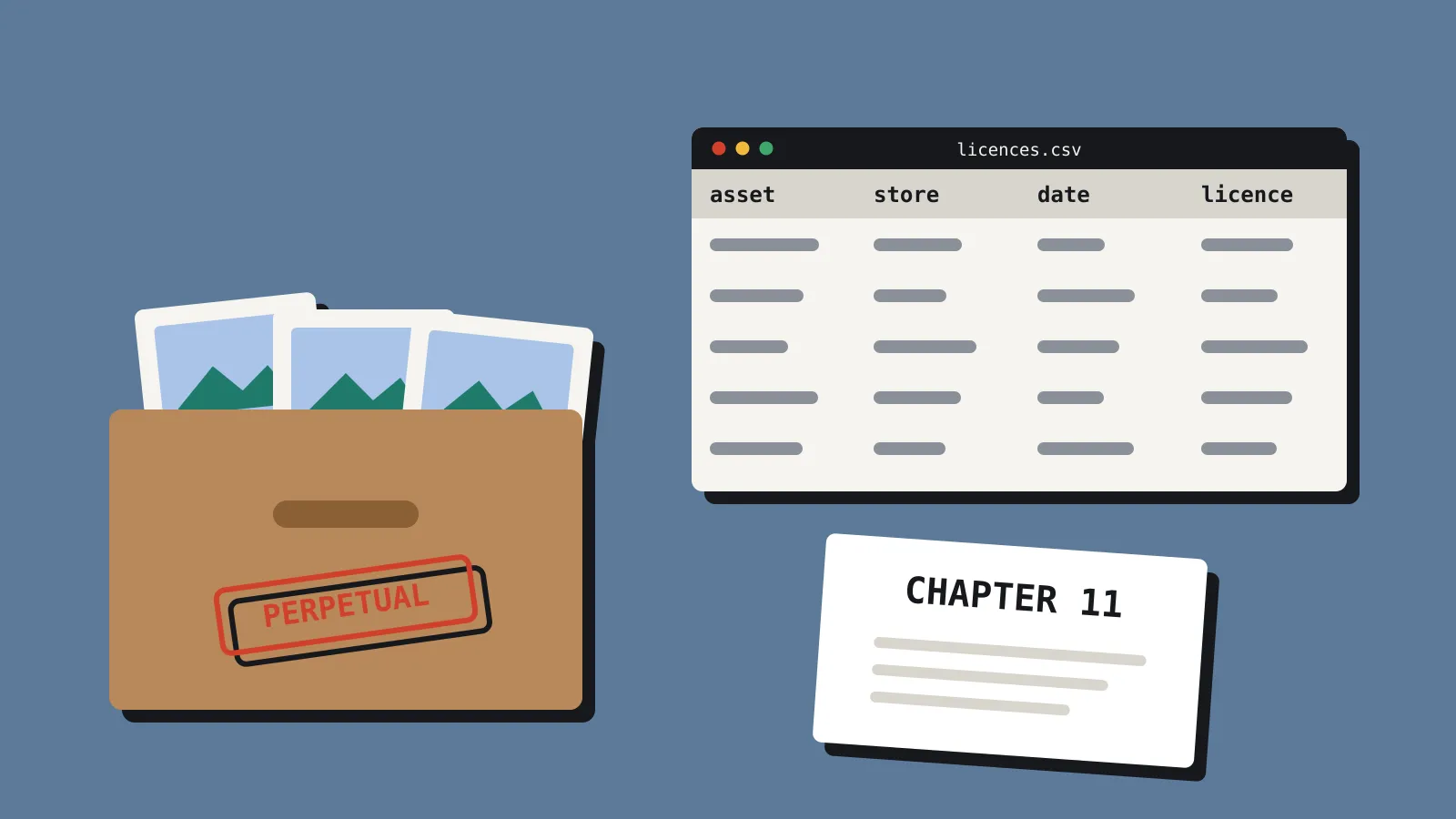
For each paid asset in your game, from any store, keep a one-line record:
- what it is and where it’s used in the game
- the store, the seller and the date you bought it
- the licence name and version, with a saved copy of the licence text
- the receipt or order number
A spreadsheet is enough. Put it in version control with the project so it can’t drift from the build.
Check the AI clause before you feed any licensed image into a generator, an upscaler or a texture tool that uploads files. If the tool’s terms let it keep or train on your uploads, keep licensed stock out of it.
Keep a credits file from day one. Unsplash doesn’t require credit, but many asset licences do, and a running list makes the final credits screen a copy and paste.
Finally, if you subscribe to Getty or iStock, know your renewal date. Subscriptions are the one place where a change of terms after a restructuring could reach you, because you agree to new terms each time you renew.
We’ll follow up if Getty’s terms change when it comes out of the process as a private company.
Sources
- Getty Images files for prepackaged Chapter 11 (Octus)
- Getty Images files for US bankruptcy (Reuters, via GV Wire)
- Getty Images files for Chapter 11 in Delaware (Bloomberg Law)
- Getty Images files for bankruptcy amid restructuring (80 Level)
- Content licence agreement (Getty Images)
- Unsplash (Wikipedia)