Most game sales now land after launch month, Newzoo finds
A Newzoo survey of 6,166 PC and console players says 73% wait for discounts more than before, so your pricing plan needs to run well past launch week.
Newzoo published a white paper on 2 November 2026 called “Game purchasing behavior in an era of choice”. It found that 73% of PC and console players are more likely to wait for a sale than they used to be, and that nearly 60% of their purchases happen after a game’s release month. The study surveyed 6,166 players in August 2026 and was produced with support from G2A.COM, a marketplace that sells game keys. Keep that backing in mind as you read the storefront numbers.
What the survey found
Newzoo polled what it calls premium gamers in six countries: the US, the UK, Germany, Poland, Brazil and Saudi Arabia. To count, a respondent had to be 18 to 55, play on PC or a current console, and have bought or played at least one AAA or AA game in the past year. Newzoo weighted the results against its Global Gamer Study so the age and gender mix matches each market.
The joint press release from Newzoo and G2A adds the detail that matters most to anyone setting a price:
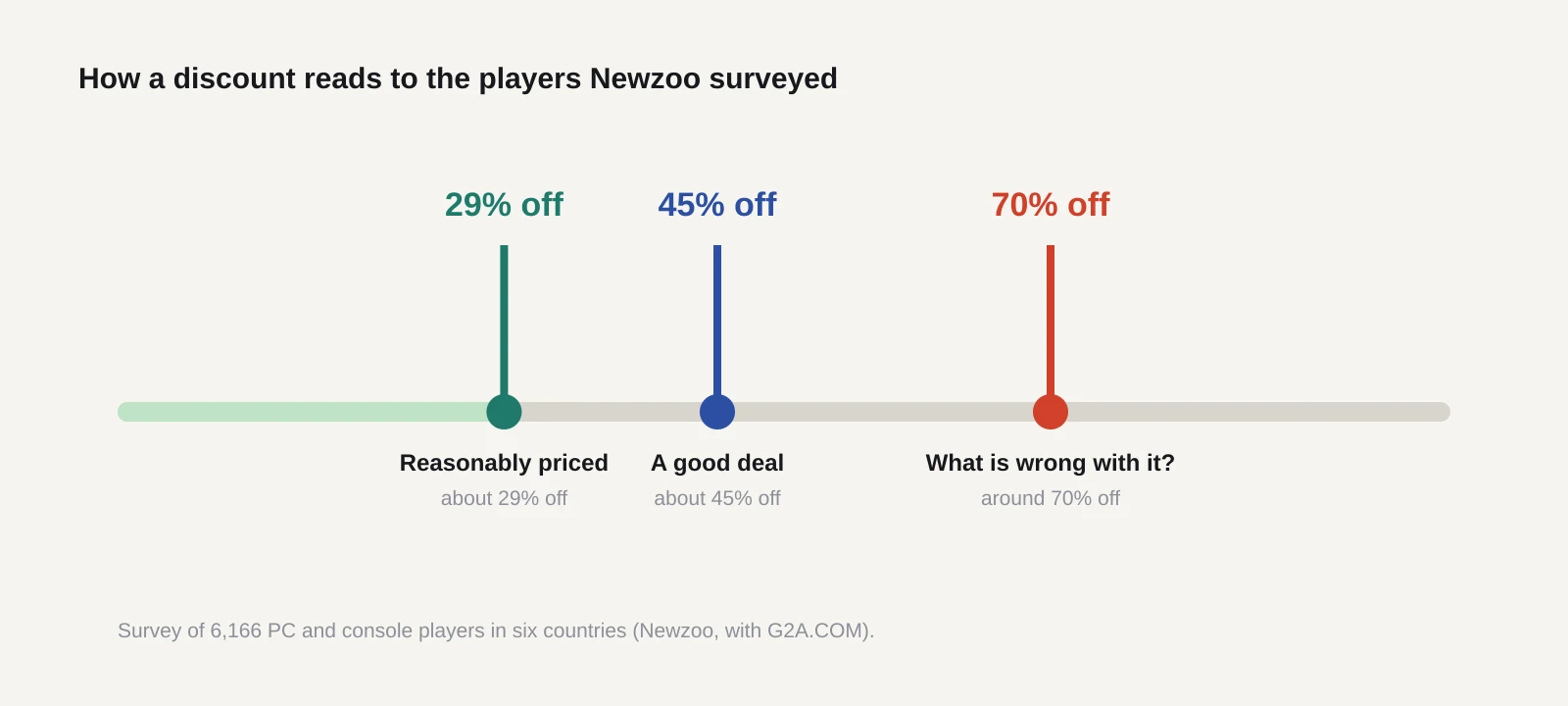
- Players start to see a game as reasonably priced at about 29% off, and as a good deal at about 45% off.
- At around 70% off, the average player starts to wonder what’s wrong with the game.
- The average wait before buying is about five months after release.
- 58% of purchases happen more than a month after launch, and 36% more than six months after.
- 37% still buy through pre-orders or early discounts in the first month.
- Premium gamers spend an average of US$368 a year on games, subscriptions and add-ons.
On subscriptions, 44% of subscribers say they buy fewer individual games since signing up. Yet 54% of subscribers also say they spend more on games overall. On storefronts, Inven Global reports that 97% of respondents use official stores. The press release puts third-party marketplaces at 24% and authorised resellers at 16% as alternative places to buy.
The full paper is free but sits behind a form on the Newzoo and G2A sites, so we’ve worked from the press release and coverage rather than the full data tables.
What it means for a solo dev
Start with the caveats. This is a survey of AAA and AA buyers facing US$70 launch prices, which the release cites as the backdrop. Someone weighing a US$70 blockbuster behaves differently from someone eyeing a US$15 roguelite. Nothing here is broken out by indie titles or by price band. G2A also sells keys, so a paper that finds players value choice of store suits its business. The survey method looks sound, but read the reseller numbers with that in mind.
Even so, the shape of the result matches what many indie devs see in their own Steam dashboards. Launch week is a spike. The long tail is where a lot of the lifetime money sits, and it’s driven by sales events, updates and visibility bumps months later. If players now expect to wait about five months and buy at 29% to 45% off, a game that’s priced and planned only for launch is leaving money on the table.
The 70% figure is the one to take seriously. Deep discounts can move units, but this survey suggests they also make players doubt the game. If you plan to go very deep, save it for when the game is old enough that a big cut reads as a clearance and not as a sign of trouble.
The subscription numbers cut both ways. A subscription deal may cost you some direct sales, but subscribers who play your game are, by this survey, more likely to buy add-ons for it. If you’re offered a subscription slot, ask what happens to your DLC sales in the same window.
What to do before release
Plan your first year of pricing before you ship, while you still have room to set it up properly. Steam’s current discount rules shape that plan, according to the Steamworks documentation:
- A launch discount is optional, runs 7 to 14 days and is capped at 40%. It must be set up before release.
- Apart from that, you can’t discount for 30 days after full or Early Access release.
- There’s a 30-day cooldown between discounts, though Valve’s seasonal sales are exempt.
- Raising your base price in any currency blocks discounts for 30 days.
With those rules, a sensible sketch looks like this. Set a base price you’re happy to discount from. Decide whether a small launch discount (Valve suggests about 10% to 15%) helps you more than a clean full price. Then map your first two or three discounts against the seasonal sales calendar, starting somewhere near the 29% mark and keeping the 45% tier for a bigger moment.
Check regional pricing at the same time. The six survey markets include Brazil and Poland, where players are price-sensitive and key resellers are popular. Steam’s suggested regional prices are a start. A low local price on the official store gives players less reason to look elsewhere. Do this before launch, because raising a regional price later triggers the 30-day discount block.
Then plan post-launch beats that line up with your discounts. A content update, a festival appearance or a new language pairs well with a sale, because you get a reason for people to look and a reason to buy at once. If 36% of purchases happen more than six months out, a six-month update is worth putting in the schedule now.
Finally, watch your own numbers instead of this survey’s. Once you’ve run two or three discounts, you’ll know your own ceiling, your own conversion rate at each tier and how fast your wishlists respond. That beats any average from 6,166 AAA buyers.
Where the numbers stop helping
Some questions this paper can’t answer for you. It doesn’t say whether players wait as long for a US$10 game as for a US$70 one, or whether the 29% comfort point holds at low prices. It doesn’t cover mobile or Switch buyers, and its six markets leave out East Asia and Australia. If the full paper breaks results down by genre or price, that’s worth requesting and checking before you build a plan on the averages.