Tasty Chef says AI made all its art. Players rated it 92%
A cosy co-op cooking game disclosed AI art and music up front and still sits at Very Positive. What the data says about AI disclosure on Steam, and what to do if you use it.
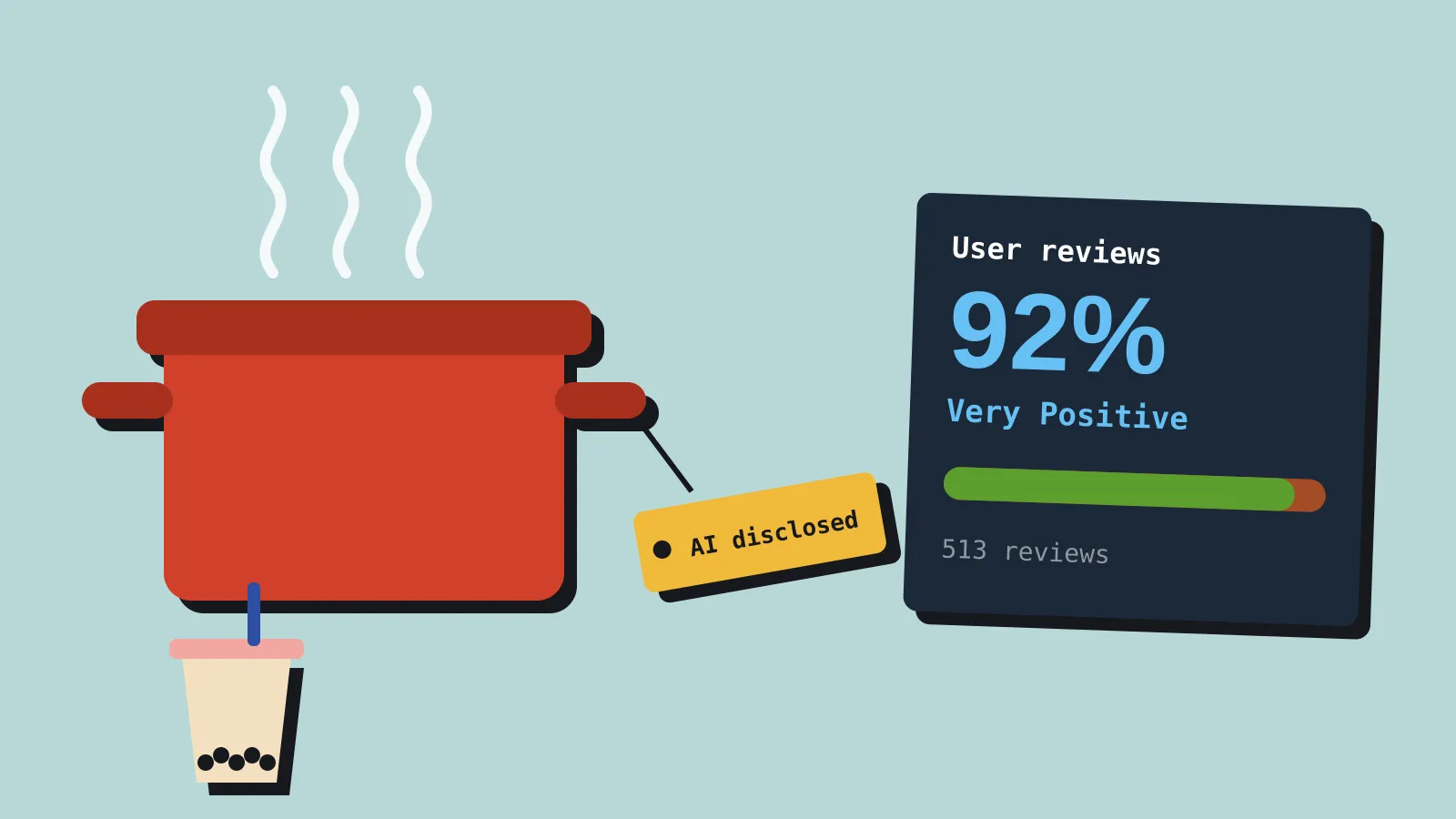
Tasty Chef, a co-op restaurant management game from Xpercent Games, launched on Steam on 23 September 2026. Its store page says generative AI made all of its visual art and all of its music. Nearly four weeks later, Steam’s own review data puts it at 92% positive from 513 reviews, rated Very Positive. That’s well above the average for games that disclose AI, and it has prompted at least one well-known game dev educator to argue that the review penalty for AI use is shrinking.
Tasty Chef is a useful test case because it did what most developers avoid: it told players up front.
What Tasty Chef is
Tasty Chef is a cosy cooking and management game. You build restaurants, design menus, cook dishes step by step, hire staff and serve customers, alone or in online co-op. It launched with a bubble tea shop and a sushi restaurant, with a bakery planned for October. It costs US$12.99 and launched with a 33% discount, bringing it down to US$8.70. It’s in 12 languages.
Its AI disclosure is short and plain. The developer says generative AI created the art and music during development, that the team reviewed and selected what went in, and that the game generates no AI content while you play. That last point matters under Steam’s rules, which treat content generated live during play separately.
What the numbers say
The reviews are solid. Steam’s review data shows 471 positive and 42 negative across all languages. The store page, filtered to your language by default, may show a slightly different figure (93% of 407 when we checked).
Sales are less clear. Code Monkey’s Game Dev Report newsletter on 18 October estimated about 25,000 copies and US$200,000 gross. Other estimates come in lower. Raijin estimates about 10,900 units and US$84,700 gross, with medium confidence. The common Boxleiter method, which multiplies reviews by 30 to 50, gives roughly 15,000 to 26,000 copies. The game peaked at 2,542 concurrent players on 27 September.
So Tasty Chef is a modest success, probably smaller than the headline figure. It isn’t a breakout hit.
Players have noticed the AI. Of the first 100 reviews Steam’s review API returned, we counted at least 15 that mention the art. Some negative reviews call it generic and say it shows no sign of human craft. Several positive reviews call the AI art the game’s weakest part and recommend it anyway, because the cooking loop is fun. Most of these reviews are in Chinese, which matters if you’re reading your own reviews in English only.
What the wider data says
Valve has required AI disclosures since January 2024. Developers declare pre-generated content (art, sound or code made during development) and live-generated content (made while the game runs). In January 2026, Valve updated the form. Tools used behind the scenes, such as coding assistants, no longer need disclosing. Anything that ships with the game and is seen by players does, including store page and marketing assets.
The best public data on review impact comes from Sulka Haro. His census of 53,597 Steam releases, published in July 2026, found that about one in three new releases in mid-2026 carried a disclosure. A follow-up compared scores:
- AI-disclosed games average 77% positive, against 81% for other games. The medians are 80% and 85%.
- The gap widens with price. At US$20 and over, it’s 73% against 81%.
- AI-disclosed simulation and management games, Tasty Chef’s genre, score about 73% to 83%.
Haro also found that AI-flagged games reach 100 reviews at about 55% of the rate of other games. That’s a correlation, and it doesn’t prove disclosure causes it. It does suggest that the bigger risk for an AI-heavy game is being ignored, rather than being reviewed badly.
Ichiro Lambe at Totally Human found something similar in November 2025. Of 10,258 Steam games with AI disclosures, he estimated 9,556 had made under five figures.
Not every disclosure goes this well
Tasty Chef sits at the friendly end of a wide spread.
Codex Mortis was marketed as the first game made 100% through AI. Its Early Access launch in March 2026 drew 60% positive from 10 reviews and peaked at 32 players, according to GameStar. Vapor World: Over The Mind, from a studio of about five people, launched in August with AI-generated cutscenes. PC Gamer reported it was Mostly Negative on 64 reviews despite 100,000 wishlists, and the studio replaced the cutscenes within about a week.
Timing matters too. Crimson Desert disclosed AI placeholder images only after launch in March 2026, and Pearl Abyss apologised. At the other end, Arc Raiders kept over 90% positive despite text-to-speech voices, and Embark has since replaced some of those lines with human actors.
The pattern across these cases: players were harsher when the game cost more, when AI was the selling point, or when they felt they’d been misled. Tasty Chef costs under US$13 and was upfront about its AI use. Its pitch is the cooking.
The asset flip comparison
Code Monkey compares AI art to the old “asset flip” stigma. Players used to sneer at recognisable store assets, then stopped caring once the games were good. He cites Tabletop Tavern, a US$19.99 roguelike wargame released in June, as a hit built partly on bought assets.
We couldn’t confirm that. What we did find in Tabletop Tavern’s reviews is players accusing it of using AI art. The developer replies that all its art, music, sound, voices, models and animation are human-made and paid for. Suspicion now lands on games that didn’t use AI at all, which is a good reason to be precise in your own disclosure.
What to do if you use AI in your game
- Disclose accurately, and early. Put it on your Coming Soon page. A disclosure added after launch costs more goodwill than one players saw before they bought.
- Count your store assets. Since January 2026, AI-made capsules, trailers and screenshots belong in the disclosure.
- Price carefully. The score gap is smallest under US$20 and widest above it.
- Read reviews in every language. Tasty Chef’s AI complaints are mostly not in English.
- Make the game the pitch. “Made with AI” didn’t sell Codex Mortis. A fun cooking loop is what’s selling Tasty Chef.
Tasty Chef doesn’t show that players have stopped caring. It shows that an honestly labelled game can get past the AI question when the game itself is good.
Sources
- Tasty Chef store page (Steam)
- Tasty Chef review data (Steam)
- Tasty Chef estimates (Raijin)
- Tasty Chef (SteamDB)
- Steam AI content policy, January 2024 (Steam)
- Valve tweaks and clarifies AI disclosure rules (Game Developer)
- Three years of AI on Steam (Sulka Haro)
- AI on Steam, part 2 (Sulka Haro)
- Games with AI disclosures have grossed an estimated $660M (Totally Human)
- Codex Mortis (GameStar)
- Steam week in review (PC Gamer)
- Crimson Desert refund denied over AI disclosure (Notebookcheck)
- Arc Raiders replacing some AI voices (Push Square)
- Tabletop Tavern store page (Steam)
- Game Dev Report newsletter, 18 October 2026 (Code Monkey)