Vulkan Video reaches Firefox on Linux, with Chromium encode next
Firefox 153 can decode video on the GPU through Vulkan on Linux, behind two prefs, and Chromium encode is in review. Here's what web game devs should check.

On 18 November 2026 Khronos published a progress report on Vulkan Video in browsers. The headline item has already shipped. Firefox 153, released on 21 July 2026, includes a zero-copy hardware video decoder for Linux built on Vulkan Video. It is off by default. Chromium work is earlier: a Vulkan encoder is in code review, and a decoder is still in development. Nothing changes yet on Windows, macOS or Android.
What actually shipped
Vulkan Video is a set of Vulkan extensions that expose a GPU’s dedicated video engine as another queue, next to graphics and compute. The Khronos post, written by Tony Zlatinski, who chairs the Vulkan Video subgroup and works at NVIDIA, argues that browsers currently juggle a separate video backend per platform. Windows has DXVA and Media Foundation, and Linux Chromium uses VA-API. Vulkan Video could replace several of those with one path on any GPU with a Vulkan Video driver.
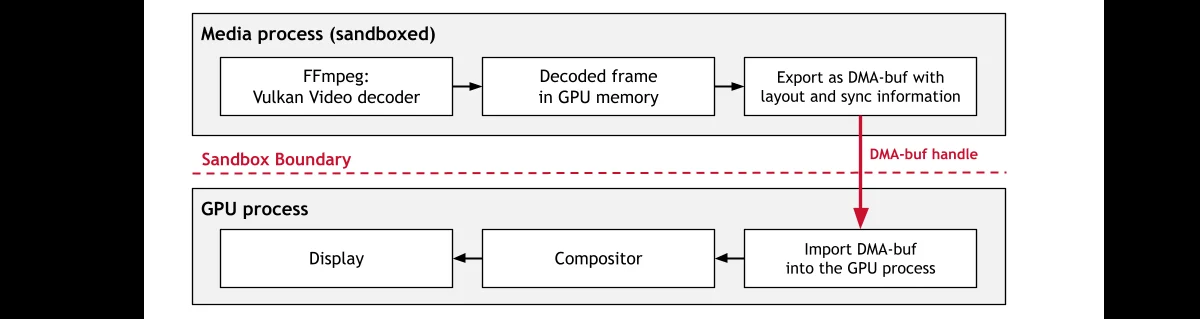
In Firefox, FFmpeg’s Vulkan decoder hands decoded frames over as DMA-bufs, which are Linux buffers that different processes can share without copying. The GPU process imports those frames and passes them to the compositor, so only a handle crosses the sandbox. The Firefox side is tracked in Mozilla bug 2021722, marked fixed for 153. The FFmpeg side landed in pull requests 22566 and 22785.
To try it in Firefox 153 or later, set two prefs to true in about:config, according to OMG Ubuntu:
media.hardware-video-decoding-vulkan.enabledmedia.hardware-video-decoding-vulkan.direct-export.enabled
The same report says NVIDIA users need driver 595 or later. That matters most for NVIDIA on Linux, because NVIDIA’s driver has never supported VA-API natively. Until now those users needed a third-party bridge to get hardware decode in the browser.
In Firefox 156, Mozilla switched Vulkan decode on for Nightly builds and recent NVIDIA hardware, per bug 2045970. Default-on for release builds is tracked in bug 2053144, which is still open with no target version. Three open bugs block it. They cover system lock-ups on NVIDIA Turing cards, a crash on Wayland with HDR colour management, and repeating frames when decoding AV1 on an RTX 3090.
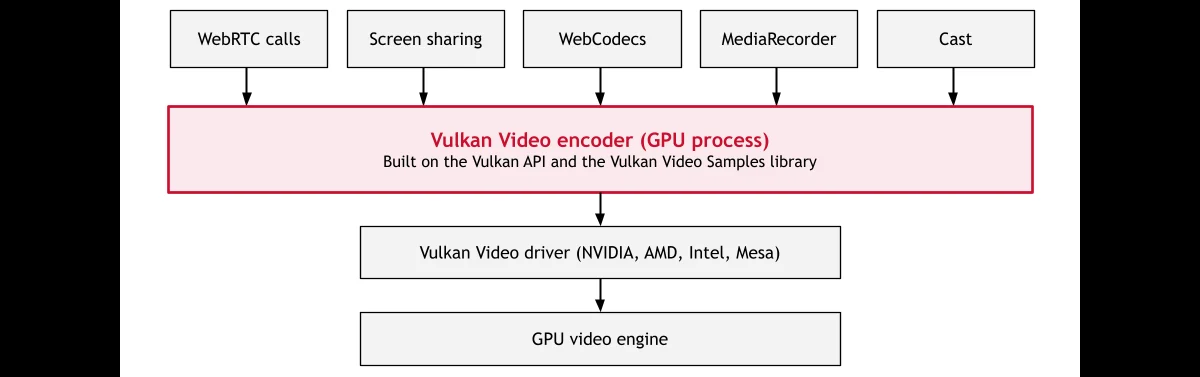
Chromium is further back. The Khronos subgroup has started upstreaming a Vulkan encoder, with two changes in review (8423941 and 8425062). It is meant to serve WebRTC calls, screen sharing, WebCodecs, MediaRecorder and Cast. Linux Chromium has had no hardware encode path at all, which is the gap this fills. A Vulkan decoder for Chromium is in development with no date. Khronos gives no Chrome version numbers and no codec list. WebGPU is not mentioned.
What it means for your web game
Most of your players won’t notice anything this year. Windows and macOS browsers already decode video on the GPU through their own APIs, and the post describes no change there. Android is listed only as a platform with Vulkan drivers.
The real change is for Linux players on NVIDIA cards using Firefox. For them, a trailer or cutscene that used to decode on the CPU can now run on the GPU, if they opt in. Lower CPU load leaves more headroom for your game loop on the same machine, and Khronos cites battery savings for laptops. Linux players on AMD and Intel already had a hardware route through VA-API, so expect less difference there. Khronos says Mesa’s RADV, ANV and NVK drivers are following, without versions.
What still doesn’t change depends on how your engine plays video:
- Phaser and PixiJS build video textures from a standard HTML video element, so they inherit whatever the browser’s decoder does, including this.
- Unity web builds play video by URL through the browser, so the same applies.
- Godot plays Ogg Theora only, decoded inside the engine. A Vulkan decoder in Firefox does nothing for a Godot cutscene.
- Construct and Defold depend on how your project or plugin creates video. If it uses a browser video element, it benefits.
Trailers embedded on itch.io pages from YouTube or Vimeo also play through the browser’s decoder, so Linux NVIDIA players with the prefs on get the GPU path without any work from you.
If you are building anything that records or streams from the browser, such as a replay clip exporter using MediaRecorder or WebCodecs, the Chromium encoder is the part to watch. Until it lands, encoding on Linux Chromium runs in software.
What to do now
- Keep H.264 as your baseline. It is the codec OMG Ubuntu calls the safe bet for the Firefox Vulkan path, and every major browser can decode it in hardware on common GPUs. Add AV1 or VP9 as extra sources if file size matters, with H.264 last as the fallback.
- Detect features instead of sniffing user agents. For WebCodecs, call
VideoDecoder.isConfigSupported()with your codec string andhardwareAcceleration: "prefer-hardware". For plain video elements,navigator.mediaCapabilities.decodingInfo()returns apowerEfficientflag, a fair hint that the GPU is doing the work. - Add one Linux row to your test matrix. Firefox 153 or later on an NVIDIA card with driver 595 or later, prefs on, playing your trailer and any video textures. Watch CPU use in a system monitor with the prefs off, then on.
- Test AV1 separately on NVIDIA. The open RTX 3090 bug means AV1 through this path can repeat frames today. If a tester reports stutter on AV1 only, this is a likely cause.
- Don’t promise Steam Deck or Chromebook gains. The Khronos post doesn’t mention either, and Chromium decode is not done.
- Keep a fallback poster frame. If decode fails, show a still image and a play button so the game still loads.
If you want to follow progress, the Chromium review links above and Mozilla bug 2053144 are the two places to watch. When either flips, we’ll report it.
Sources
- Vulkan Video Acceleration Comes to Browsers, source of the images (Khronos Group blog)
- Vulkan Video Acceleration Comes to Browsers (GameDev.net syndication)
- Bug 2021722: Add Vulkan Video path to FFmpegVideoDecoder (Mozilla Bugzilla)
- Bug 2045970: Enable Vulkan video HW decode on qualified devices (Mozilla Bugzilla)
- Bug 2053144: Enable Vulkan video decoding by default on Linux Desktop (Mozilla Bugzilla)
- Firefox is adding Vulkan video decoding for Nvidia GPUs (OMG Ubuntu)
- Firefox 153 available with support for Vulkan Video decoding (Phoronix)
- Firefox 153 lands Vulkan Video decode support (Linuxiac)