Some IGF jurors won't vote for any AI use. Plan your disclosure
Nineteen IGF jurors say they'll skip any game that used generative AI, even for a bug fix. Here's how the disclosure rules differ, and what to record now.
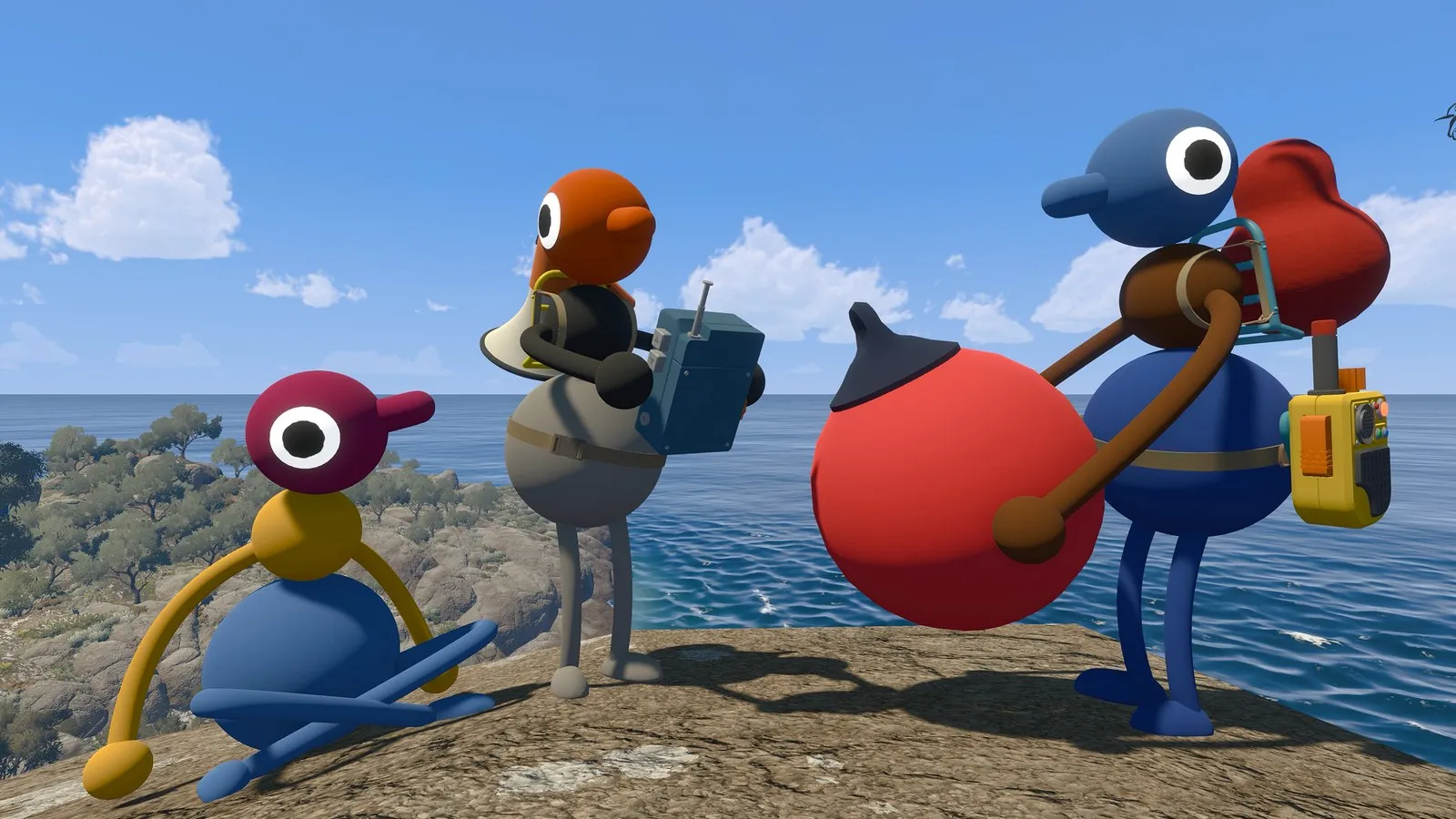
On 9 November, 19 jurors for the 2027 Independent Games Festival (IGF) said they won’t vote for any game that used generative AI “in any capacity” this year. That includes code. A day later House House, the studio behind Untitled Goose Game, published a note saying chatbot suggestions shaped well under 0.1% of the code in its August release, Big Walk. The studio had first written that note for its IGF entry.
The story matters to you if you enter juried festivals, or if you’ve ever pasted a chatbot’s answer into your project. The rules on what you must disclose, and who reads the answer, now differ a lot from place to place.
What the jurors said
The statement went out as a Bluesky post from Austin Walker, and Aftermath published the full list of signatories. They include Sam Barlow, Lena Raine, Brendon Chung and Megan Fox. Not every juror signed. Aftermath reported that some who shared the concerns held back because they feared professional backlash.
The jurors point to a sharp rise in IGF entries built with generative AI tools. They list harms they see in the technology, from energy use to pressure on artists’ and programmers’ jobs, and say those harms apply to code as much as to art. They also object to models trained on people’s work without consent.
They want the IGF to bar any AI-generated work from future years. For now, the festival has only said jurors may vote by their own tastes and values. Aftermath reported that IGF leadership approved the statement’s release, and the jurors say they don’t speak for the IGF. The festival’s public page still carries the 2026 rules, and we couldn’t find a written AI rule there.
The stakes are real for a small team. The Seumas McNally Grand Prize pays US$10,000, the other main awards pay US$2,000, and every finalist team gets a US$1,000 travel stipend. Winners are announced during GDC, which runs from 1 to 4 March 2027.
What House House actually disclosed
The Big Walk FAQ says the team used chatbots “sparingly” in the final stretch, mostly to research problems in third-party code. Its main example is a shadow bug in Unity’s Universal Render Pipeline (URP). URP only culls shadow casters by distance along the camera’s forward direction, so shadows behind the player were drawn at any distance. That cost roughly half the frame rate for about 20 seconds at every sunrise and sunset.

The team says it had researched the problem itself and asked a Unity engineer, who told them it couldn’t be done. A chatbot then pointed to a possible fix after some dead ends. The team reworked it into about 10 lines inside URP. The FAQ says no generative AI went into art, writing or anything else.
The studio didn’t flag any of this on Steam, because Steam doesn’t ask about code or chatbot use. It called its lack of an internal AI policy a failure and apologised to people who oppose the technology. Not everyone accepts the “one bug” framing: developer Bruno Dias pointed out on Bluesky that the note describes several instances, though mostly consultative ones.
Why the disclosure rules don’t line up
Each place you ship asks a different question.
- Steam: since January 2026, the content survey only asks about AI-generated material that ships in the game or its marketing and that players see or hear, plus guardrails for anything generated live. Coding helpers and office tools are excluded.
- itch.io: since late 2024, games and asset packs that use generative AI need the “AI Generated” tag. Untagged AI asset packs get pulled from browse pages.
- The IGF: the entry asked about AI use. House House called it a suggested part of the submission, and Dias said the IGF required it. Either way, jurors read the answer.
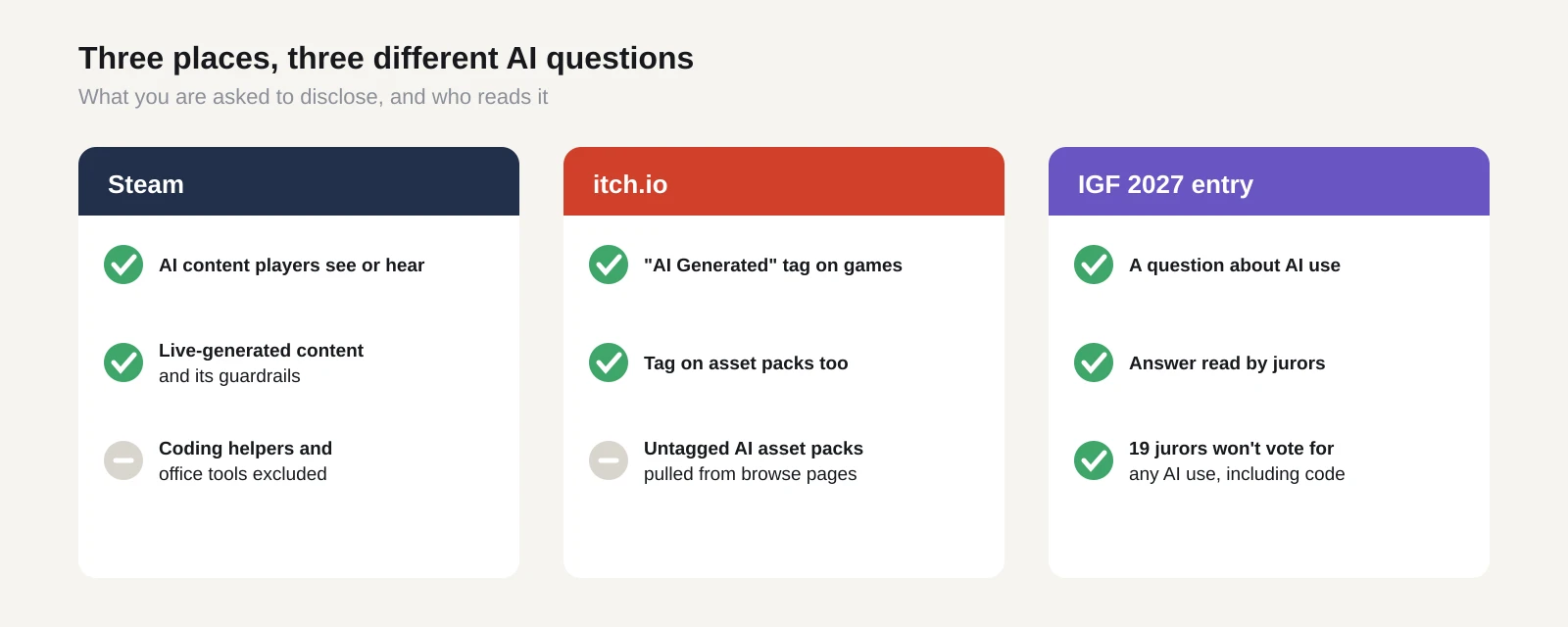
So the same game can answer “no” on Steam and “yes” for the IGF, and both answers are true. That gap is the real problem for indies. A careful, honest disclosure written for one audience can be read by a stricter one.
The wider context helps here. In GDC’s latest State of the Game Industry survey, reported by GamesIndustry.biz on 12 November, 40% of developers said they use generative AI at work. Only 9% of indie respondents said they feel pushed to use it, compared with 27% at AAA studios. Many indie teams are choosing these tools, and many jurors have now said they’ll count that against them.
What it means for a solo dev
If your game used AI anywhere, even to explain an error message, expect some IGF jurors to pass over it. That may hold for other juried festivals too, as organisers look at this case. The scope of the use won’t necessarily matter to them.
Honest disclosure is still the right call. Entry forms ask, and a disclosure that surfaces later costs far more than one made up front. The awkward part, which critics of the jurors have raised, is that this approach penalises the studios that tell the truth. You can’t fix that. You can make sure your answer is accurate and that you can back it up.
If your game is AI-free, say so plainly and keep the evidence. That’s harder than it sounds. AI features now sit inside engines, code editors, upscalers and some asset packs you may have bought.
What to do now
- Write a one-page AI policy for your project: which tools are allowed, for which tasks, and who decides. House House’s main regret was not having one.
- Keep a simple log of any AI use, with the date, the tool, the task and what you kept. Ten minutes a week is enough.
- Check your third-party assets and plugins. Look for itch.io AI tags and read store listings and plugin docs for generative features.
- Read each festival’s entry form before you build your submission, and answer the question it asks at the level of detail it asks.
- Draft a short public note now, in the style of the Big Walk FAQ, so you’re not writing one under pressure later.
- If you used AI and you’re weighing the IGF, factor the jurors’ position into whether the entry fee and the time are worth it this year.
We’ll update this piece if the IGF publishes a written AI rule for 2027.
Sources
- Some IGF jurors are declining to vote for any game that uses generative AI (Aftermath)
- Jurors’ statement (Austin Walker on Bluesky)
- Big Walk FAQ, AI section (House House)
- Independent Games Festival (GDC)
- House House discloses AI use for under 0.1% of Big Walk’s code (Game Informer)
- How 10 lines of AI debugging code led to an Indie Game Awards boycott (Inven Global)
- Steam updates its AI disclosure form (PC Gamer)
- Itch.io now requires gen AI content to be tagged (GamesMarket)
- GDC State of the Game Industry: 40% of developers use generative AI (GameDev.net via GamesIndustry.biz)