Outersloth warns of very bad publishing deals. Check these terms
Innersloth co-founder Forest Willard says he has seen abysmal publishing deals signed by indie devs. Here are the terms to check before you sign yours.
Innersloth co-founder Forest Willard, who runs the studio’s Outersloth fund, told Game Developer on 20 October 2026 that some indie publishing deals are truly terrible. He spoke at the Seattle Loves Indies Creator Expo (SLICE) 2026. Willard said he has reviewed contracts other developers have signed and found terms that leave little chance of earning money after launch. He didn’t name publishers or describe specific clauses. He did say he has considered publicly offering to sign developers stuck in bad deals, though he worries about being swamped.
Why a fund boss is saying this out loud
Willard isn’t a neutral observer. Outersloth funds other studios’ games, so it competes with the publishers he is criticising. That said, Outersloth has put its own terms on the table. Innersloth published its full contract on 9 March 2026, with personal details redacted. At the time it said the fund had backed 24 games.
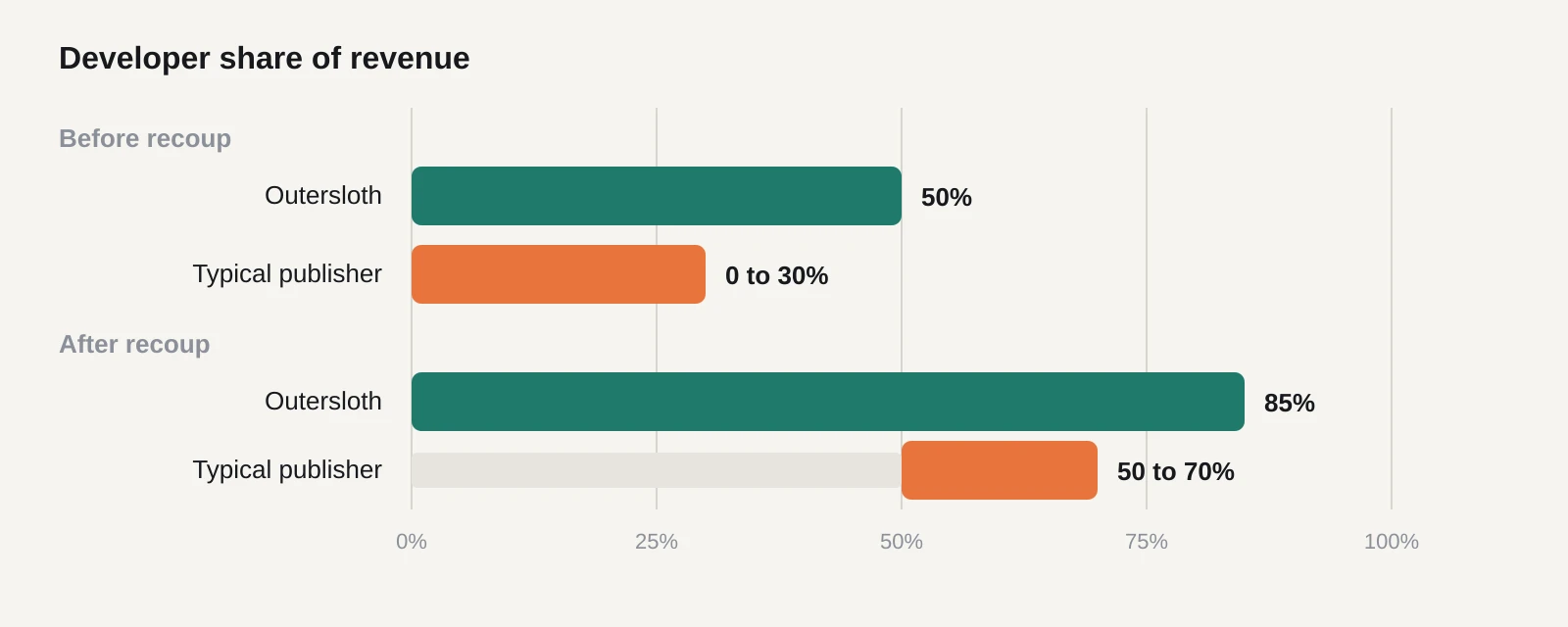
According to Mothership’s write-up of that contract, Outersloth splits revenue 50/50 until it recoups its investment. After that it takes 15 per cent and the developer keeps 85 per cent. The deal runs for seven years after release, whether or not the fund recoups. The studio keeps the IP. Outersloth’s own page says funding usually sits between US$50,000 and US$2 million, and that it doesn’t want your IP.
There’s a catch worth knowing. Outersloth is a fund, not a publisher. Developer Laura Michet pointed out on her blog that it offers no marketing, release management or vendor support. A publisher doing that work will reasonably ask for more. The question is how much more, and on what terms.
Willard isn’t alone. Hooded Horse CEO Tim Bender argued on the Game Developer Podcast in February that many publishers aren’t treating developers fairly. He has also suggested many indies would do better self-publishing.
What “bad” tends to look like
Two public guides give useful benchmarks. Rami Ismail, writing in his Level Up Your Publishing guide, says publishers typically take 70 to 100 per cent of revenue before recoup and 30 to 50 per cent after. At the top of that range, he warns you may see no launch income for three to six months, or ever.
Akupara Games, itself a publisher, posted a red flags guide in February 2026. It treats a 100 per cent recoup before the developer earns anything as a warning sign. It also flags deals where the publisher recoups 110 to 200 per cent of what it spent, or adds management fees. The post describes that as hidden interest.
Compare those with Outersloth’s split and you can see the spread. The same game can earn you very different money depending on two numbers and one definition.
What it means for a solo dev or small team
If you’re a solo dev, the publisher has more lawyers and more time than you. They also know the standard clauses better. That gap is where bad terms slip through.
The terms that hurt most usually aren’t the headline split. They’re the definitions behind it. What counts as revenue? What counts as a recoupable cost? When does the term end, and what happens to the game then? A 50 per cent post-recoup share means little if recoup never arrives.
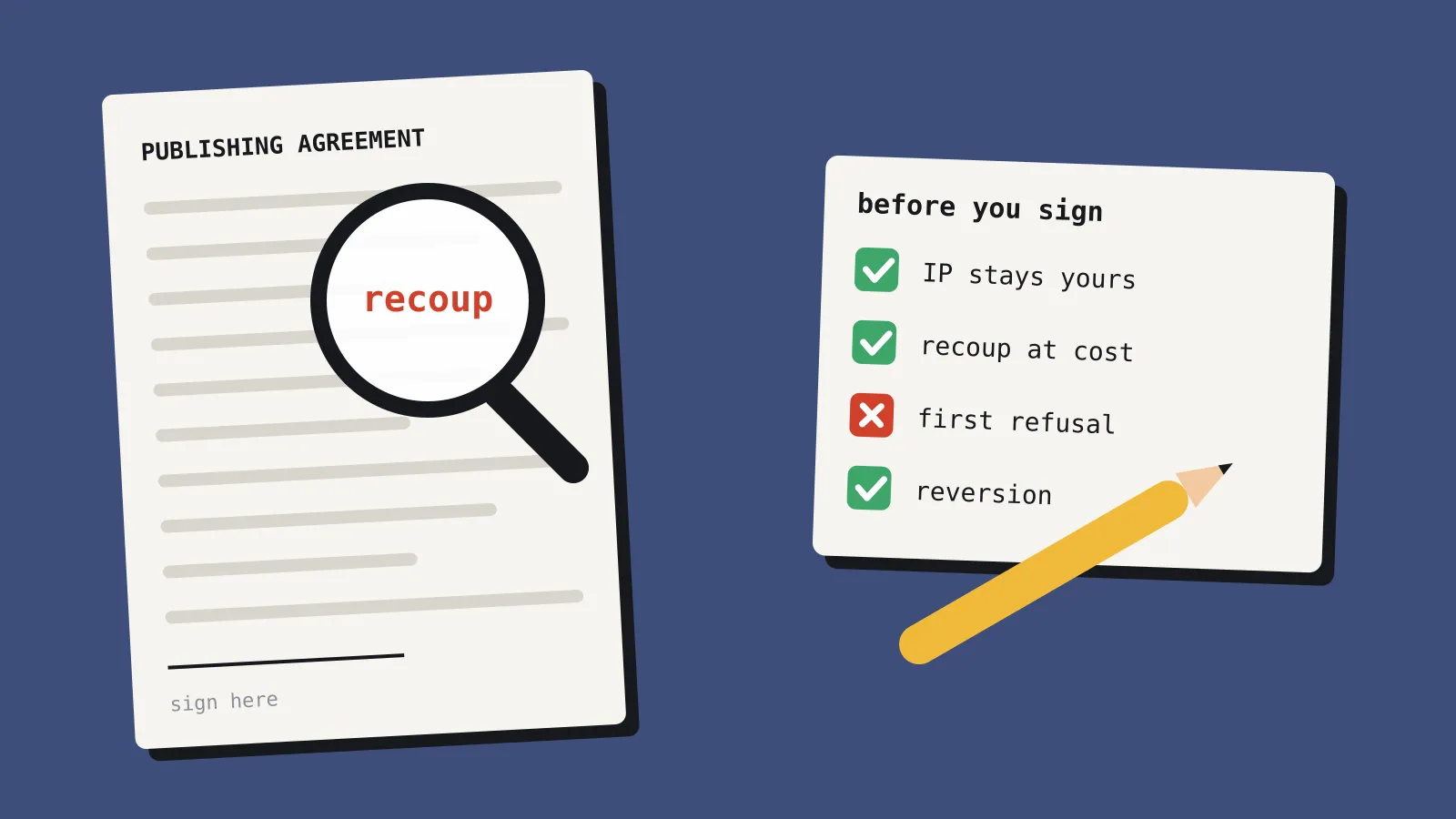
Rights to your next game matter too. Ismail says a right of first negotiation is generally fine. A right of first refusal, where you can’t shop a project until the publisher passes, is a red flag. Akupara suggests limiting any option to direct sequels, with short decision windows.
This isn’t legal advice. Before you sign anything, get a games lawyer to read it. Ismail notes that many offer a free first consultation.
What to do now: the checklist
Treat the first draft as an opening offer. Work through each of these and push back where the answer is vague.
- Recoup order. Ask whether you earn anything before recoup. Akupara argues you should be paid from day one. A partial split before recoup is better than nothing.
- Recoupable costs. Get a closed list. Ismail says recoupable costs should be external services only, not the publisher’s salaries or office gear. Cap recoup at documented, actual spend, as Akupara suggests. Strike any margin or admin fee.
- What counts as revenue. Check whether platform exclusivity deals, subscription service payments, merch and outside funding count toward recoup. Ismail flags these as easy to miss.
- Rev share after recoup. Know the number, and check it moves in your favour once the publisher is paid back.
- IP ownership. Keep it. Akupara calls a full IP assignment, especially in perpetuity, a major red flag. A limited licence with a defined scope is the safer shape.
- Sequel and port rights. Limit any option to direct sequels. Accept first negotiation, refuse first refusal. Confirm who controls ports to new platforms.
- Term and territory. Ismail says most publishers ask for five to ten years, and some want perpetuity. Check what happens at the end. Make sure territory matches what the publisher can actually sell into.
- Marketing in writing. “Marketing” alone means nothing. Ismail advises defining the budget, what it covers and whether you have a say. Ask for definitions of “reasonable efforts” and similar phrases.
- Audit rights and reporting. Akupara recommends at least quarterly statements and a practical audit right. Ask how often you get paid and how fast.
- Reversion clauses. You need a way out. Look for rights that return to you if sales fall below a threshold, the publisher breaches, or a set period passes.
- Milestone payments. Define every milestone. Ismail notes that words like “alpha” have no legal meaning unless the contract defines them. Set a deadline for the publisher to approve each one, so slow sign-off can’t stall your cash.
Plan your cash flow too. Ismail says backend payments usually start three to six months after release, because stores can take up to three months to pay out. Your funding needs to cover that gap.
Finally, read Outersloth’s published contract even if you never pitch to them. It’s a real, public reference point. When a publisher tells you a term is industry standard, you’ll have something concrete to compare it with.
Sources
- Innersloth co-founder warns devs: “there are some very bad deals out there” (Game Developer)
- The Outersloth contract (Innersloth)
- Outersloth (Innersloth)
- How Outersloth’s investment fund contracts upend the status quo for indie developers (Mothership)
- Outersloth released its contract terms publicly (Laura Michet’s blog)
- Publisher contract red flags (Level Up Your Publishing, Rami Ismail)
- Publisher red flags: what to look for in contracts and negotiations (Akupara Games)
- How publishers can do better by devs and still profit (Game Developer Podcast ep. 65)