Web stores only pay if you run them like a product
Speakers at PGC Nordics said a direct-to-consumer store needs constant work to earn its margin. Here's how a small team can decide whether to open one.
Selling your game directly to players, without a platform in the middle, was one of the biggest topics at Pocket Gamer Connects Nordics in Helsinki on 20 and 21 October. The message from the stage was blunt. Opening a web store is the easy part. Making it earn more than the platform cut you avoided takes ongoing work, and most of that work lands on the studio.
The talks were aimed mostly at mobile publishers with live games. The lessons still apply if you’re a solo dev wondering whether to sell keys from your own site or open an itch.io page alongside Steam.
What the speakers said
Ola Dokun, who leads strategic insights and market intelligence at payments company Xsolla, argued that a webshop on its own doesn’t count as a direct-to-consumer (D2C) strategy. She traced the shift to roughly 15 years of pressure on platform fees, plus Epic’s move to add direct purchases to Fortnite. Her advice was to plan for change. Fees and regulation keep moving, so a strategy built only on today’s numbers can stop working.
In the PocketGamer.biz weekly newsletter, deputy editor Paige Cook summed up the event’s D2C theme: a store has to be run like a product. That means daily support and regular improvements that give players a reason to come back. Daria Berdnikova, Coda’s senior director of sales for EMEA, put it simply: a store that exists won’t automatically sell. She said the first purchase is often the hardest to win, and that keeping a buyer coming back is a separate job.
Berdnikova also stressed local payment methods. Her example was a publisher expanding into Japan that added PayPay, a popular Japanese mobile wallet, to its checkout and saw good results. In a separate PocketGamer.biz interview on 15 October, she said publishers entering new markets need flexibility on payments, pricing, regulation and tax, without building a new operation for every country.
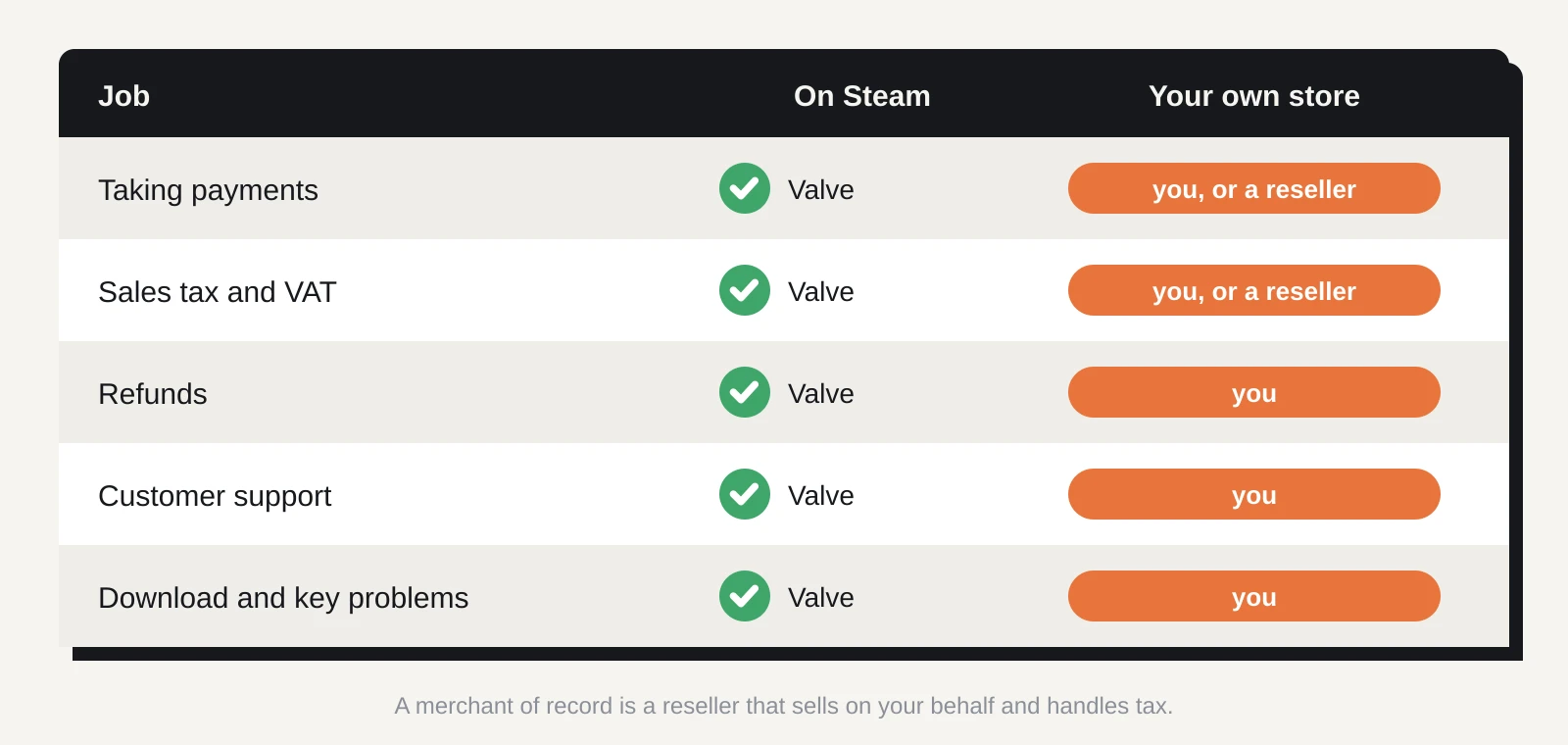
Dokun added that D2C comes with work that platforms normally absorb. Cook’s write-up lists customer support and refunds. Those are jobs Steam, Apple and Google currently handle for you.
What it means for a solo dev or small team
Most indie developers aren’t running a mobile live game with a shop full of currency packs. For a premium PC game, D2C usually means one of three things: selling Steam keys from your own site, selling DRM-free builds on itch.io, or a crowdfunding or pre-order page. Each one saves some of the platform cut and adds work.
Start with the margin. Steam’s standard cut is 30%. Selling direct still costs you payment processing, and the tax rules don’t go away. If you sell to EU players yourself, you’re responsible for VAT on each sale unless a merchant of record (a reseller that sells on your behalf and handles tax) takes that on. itch.io lets you pick its revenue share, and its “collected by itch.io, paid later” payout option handles EU VAT for you. If you choose direct payouts to PayPal or Stripe instead, you take on more of the VAT work.
Next, check the platform rules. Valve’s Steam key guidelines say Steam customers shouldn’t get a worse deal than people who buy keys elsewhere. You can run a temporary discount on another store, but only if you plan to offer something comparable on Steam within a reasonable time. Valve also limits key requests. A launching game can usually get up to 5,000 keys, and Valve may turn down a request that’s out of proportion to the game’s Steam sales. So a cheaper direct price, the obvious lever for a web store, mostly isn’t available to you.
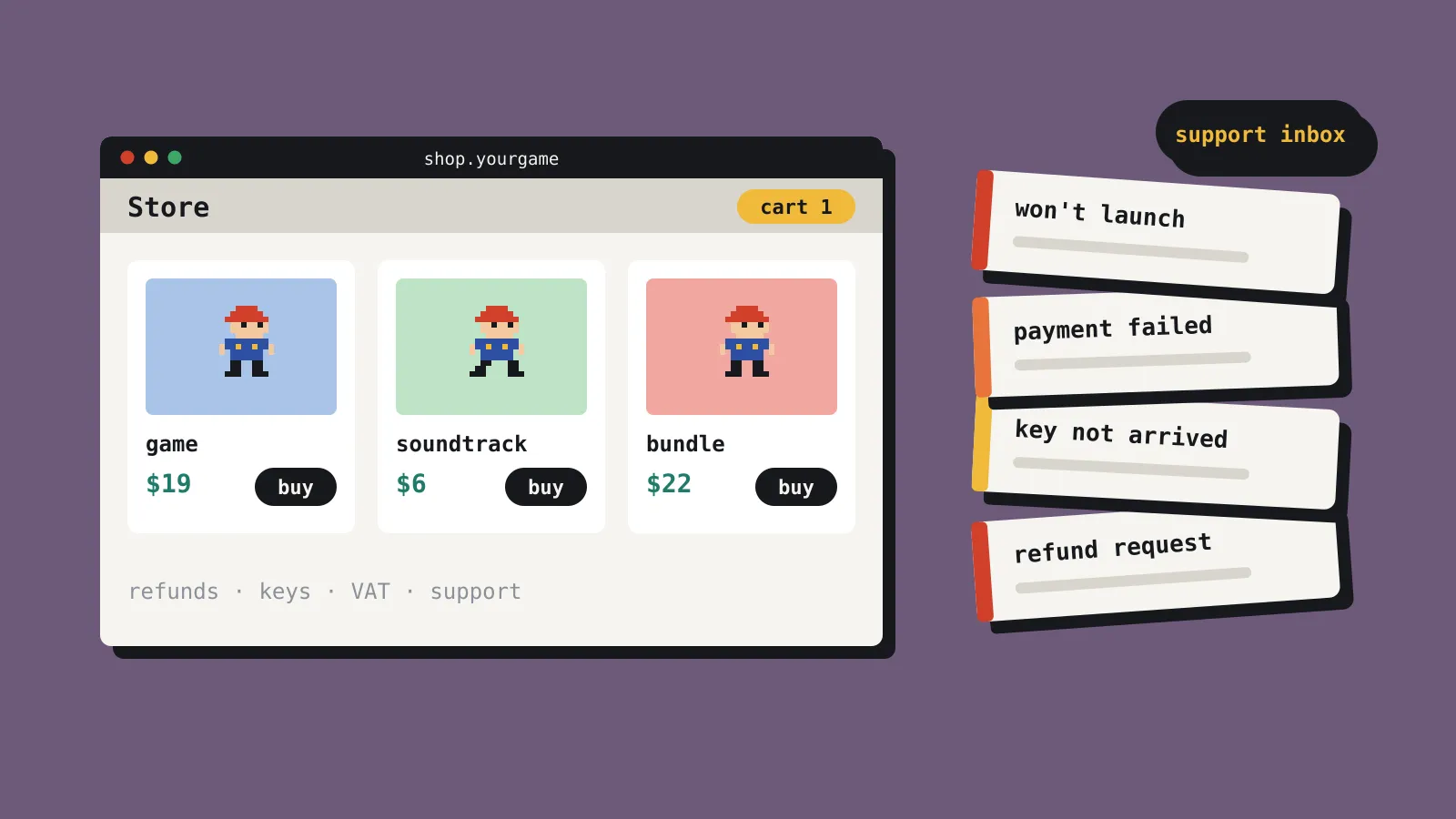
Then count the hours. Every refund request, failed payment, lost key email and “it won’t launch” message that Steam would have handled now comes to you. At a small scale that might be a few emails a week. During a launch spike it can take over your days, just when you need them for patches.
The upside is real but modest. You get the buyer’s email address (with consent), a closer relationship with your most committed players, and a sales channel that doesn’t depend on one storefront’s algorithm. For a game with a strong community, such as one built on Patreon, Discord or a successful Kickstarter, that can be worth the overhead.
What to do now
Decide on purpose before you launch, and write the decision down.
- Work out the real margin. Take your price, subtract payment fees, VAT handling and any merchant of record fee, and compare it with Steam’s 70% share. Use real quotes, not estimates.
- Read the key rules. If you plan to sell Steam keys, read Valve’s key guidelines in full and price your direct sales the same as Steam.
- Pick a merchant of record or itch.io. Unless you want to handle global sales tax yourself, use a service that sells on your behalf. Compare fees, payout schedules and which local payment methods each one supports.
- Budget the support time. Set aside a fixed weekly slot for store support, and write canned replies for refunds, lost keys and launch problems before release day.
- Give buyers a reason to come back. A store with one product and no updates gets one visit. Think about what returning buyers get: soundtrack bundles, early builds, a newsletter, or DLC on the same page.
- Review after three months. Compare direct revenue with the hours spent. If the store isn’t covering its time, close it and point buyers back to Steam. There’s no shame in that.
For most solo devs, the honest answer will be to stay on the platforms and spend the saved time on the game. If you already have a community that wants to pay you directly, a well-run store can work. The speakers’ point was simply that it needs running.
Sources
- Agree IP terms early, cut through AI hype, stop overloading players: Four lessons from PGC Nordics (PocketGamer.biz)
- Coda’s Daria Berdnikova on D2C and global commerce (PocketGamer.biz)
- Steam Keys documentation (Steamworks)
- Creator FAQ (itch.io)
- PocketGamer.biz weekly newsletter, 23 October 2026 (editorial by Paige Cook)