How to tell Brussels what the DFA does to your game by 15 January
Follow-up: the EU's Digital Fairness Act proposal is open for public feedback until 15 January 2027, and small studios with real numbers are the voices it lacks.

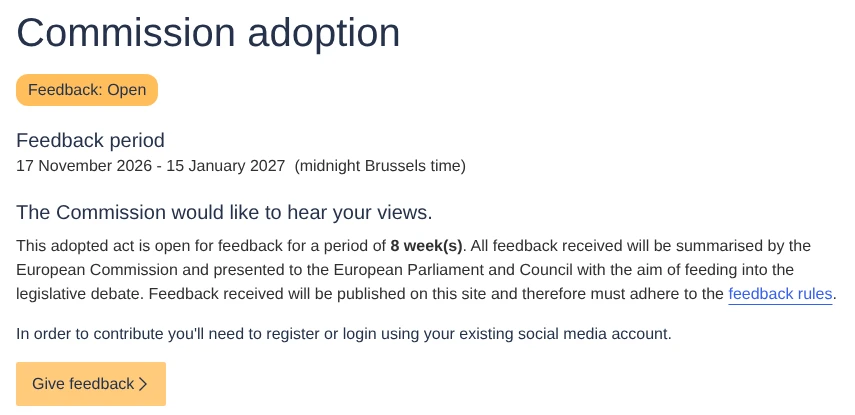
The European Commission opened public feedback on its Digital Fairness Act (DFA) proposal on 17 November 2026, according to PocketGamer.biz. The Commission’s page lists the window as running until 15 January 2027, midnight Brussels time. Anyone can comment on the Commission’s Have your say page for the DFA, and every response is published. If the draft worries you, this is the cheapest moment you will get to say so.
A quick recap of the proposal
We covered the games rules when the proposal (COM(2026) 1100) landed on 11 November, in The EU wants loot boxes and pay-to-win off limits to under-18s. In short, Article 14 makes you show the real-money price of virtual currency, Article 15 restricts loot boxes, and Article 16 bans pay-to-progress mechanics where minors are reasonably likely to play. There is no small-business exemption from those rules, and fines can reach 6% of global annual turnover.
What’s new is the feedback window. This stage covers the adopted proposal, the actual legal text, so comments can point at specific articles and wording. The Commission’s Better Regulation toolbox says it summarises this feedback and sends it to the European Parliament and Council. Those two bodies now negotiate the final law. PocketGamer.biz notes the deadline may shift later, because the window runs until the text is out in every EU language.
Why the GamesIndustry.biz analysis says indies feel it most
Lawyer Dr Andreas Lober wrote a briefing for GamesIndustry.biz on 20 November, mirrored on GameDev.net. (GamesIndustry.biz blocks automated fetching, so we read the mirror.) His central point is compliance load. The DFA sits on top of several other EU consumer and platform laws. Big publishers have legal teams to map those overlaps. A five-person studio does not, yet it faces the same rules and the same 6% ceiling.
Lober flags two design problems in particular. First, the draft may require the real-money value to appear again when currency is spent, and not only at purchase. That gets messy in games that mix earned and bought currency. Second, the draft treats pay-to-progress like pay-to-win. Read broadly, that could reach paying for the full game after a free demo, or ordinary paid DLC.
The German trade body game made a related point in its 11 November response. It said most of Europe’s roughly 8,700 games companies are small studios. It also argued that enforcement tends to land on EU-based firms, while non-EU rivals often ignore the rules.
Where small-studio feedback can still move the text
Four parts of the draft look most open to argument, based on the coverage so far.
- The minors test. Law firm Lewis Silkin reads recital 62 as treating any game with a PEGI rating under 18 as directed at minors. game argues this lumps six-year-olds in with 17-year-olds. If your game is rated PEGI 12 for mild violence but has no child audience, say so with your player data.
- The pay-to-progress definition. Lewis Silkin finds no formal definition, only examples in recital 65 such as artificial difficulty walls. Tell the Commission which of your normal monetisation choices could be caught: a demo that upgrades to the full game, a soundtrack bundle, an expansion.
- Compliance cost for small teams. Estimate what changes would cost you in hours and money: UI work, legal advice, extra builds for EU players. Few submissions will have numbers like these, so yours will stand out.
- Interaction with PEGI and USK. If you already rate through IARC, the free rating system most digital storefronts use, explain how a fixed under-18 test interacts with it.
What it means for a solo dev or small team
If you sell in the EU, the final law applies to you, wherever you are based. A&O Shearman notes the DFA would apply 12 months after it enters into force. The legislative process typically takes about 17 months, so the rules are probably at least two years away.
Feedback from a small studio carries weight because it is rare. The 2025 call for evidence drew 4,325 responses, PocketGamer.biz reports, and many came from large companies, trade bodies and campaigners. A specific account of how Article 16 would hit your actual game is harder to wave away than a general warning about “the industry”. Responses are public, so keep anything commercially sensitive out.
You do not have to oppose the whole act. game itself backs some alternatives, such as purchases switched off by default for children and simpler refunds. Saying “this part is fine, this part breaks my game” is useful input.
What to do now: submit in under an hour
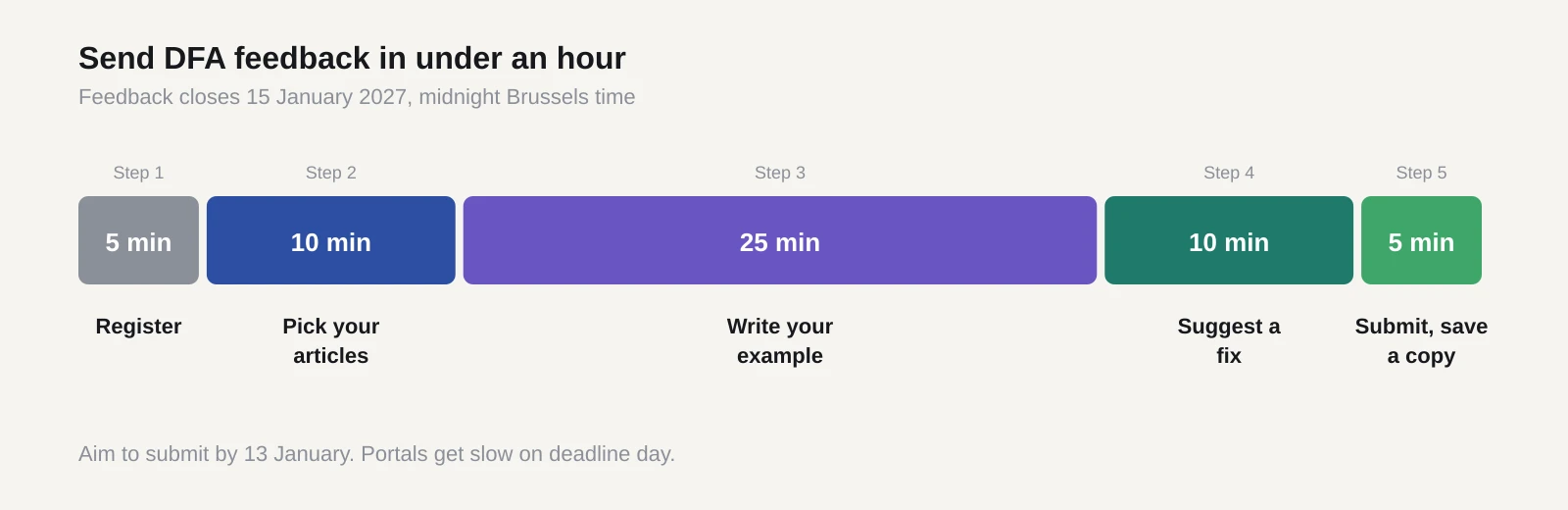
- Register (5 minutes). Open the Have your say page and sign in or create an EU Login account. That is the Commission’s free sign-on.
- Pick your articles (10 minutes). Choose one or two from Articles 14 to 16 that touch your game. Note the article number.
- Write your example (25 minutes). Describe your game, its rating, its audience and how it makes money. Then explain what the article would force you to change, and what that costs. Use numbers: player age split if you have it, revenue share from the affected feature, estimated hours.
- Suggest a fix (10 minutes). Propose wording or a threshold. For example, a narrower pay-to-progress definition that excludes a one-off purchase of the full game.
- Submit and save a copy (5 minutes). Choose whether to publish under your name or anonymously, then keep your text.
If writing alone feels like too much, check whether your national association is preparing a response. game (Germany), Ukie (UK) and the European Games Developer Federation (EGDF) have all criticised the draft publicly. Send them your example and numbers so they can cite them. You can still submit your own response as well.
Aim to submit by 13 January. The Commission’s “midnight Brussels time” could fall as early as mid-morning on 15 January in eastern Australia, and portals get slow on deadline day.
Sources
- Digital Fairness Act, Have your say, source of the feedback panel image (European Commission)
- Better Regulation toolbox, chapter 7: stakeholder consultation (European Commission)
- Have your say: feedback on the EU’s DFA proposal is open until January 14th, source of the cover photo (PocketGamer.biz)
- How the EU’s Digital Fairness Act will impact game design, Andreas Lober for GamesIndustry.biz (GameDev.net)
- Digital Fairness Act: European Commission hits games with double regulation (game, via Games Press)
- Come on now, play fair: what the Digital Fairness Act means for video games (Lewis Silkin)
- Digital Fairness Act: the European Commission’s proposal (A&O Shearman)
- The EU wants loot boxes and pay-to-win off limits to under-18s (indietooling)