Nobody can afford new hardware. Build for what players own
Console and GPU sales are at multi-year lows, and prices may not ease until 2028. What that means for your minimum specs, your test machine and your Mac build.
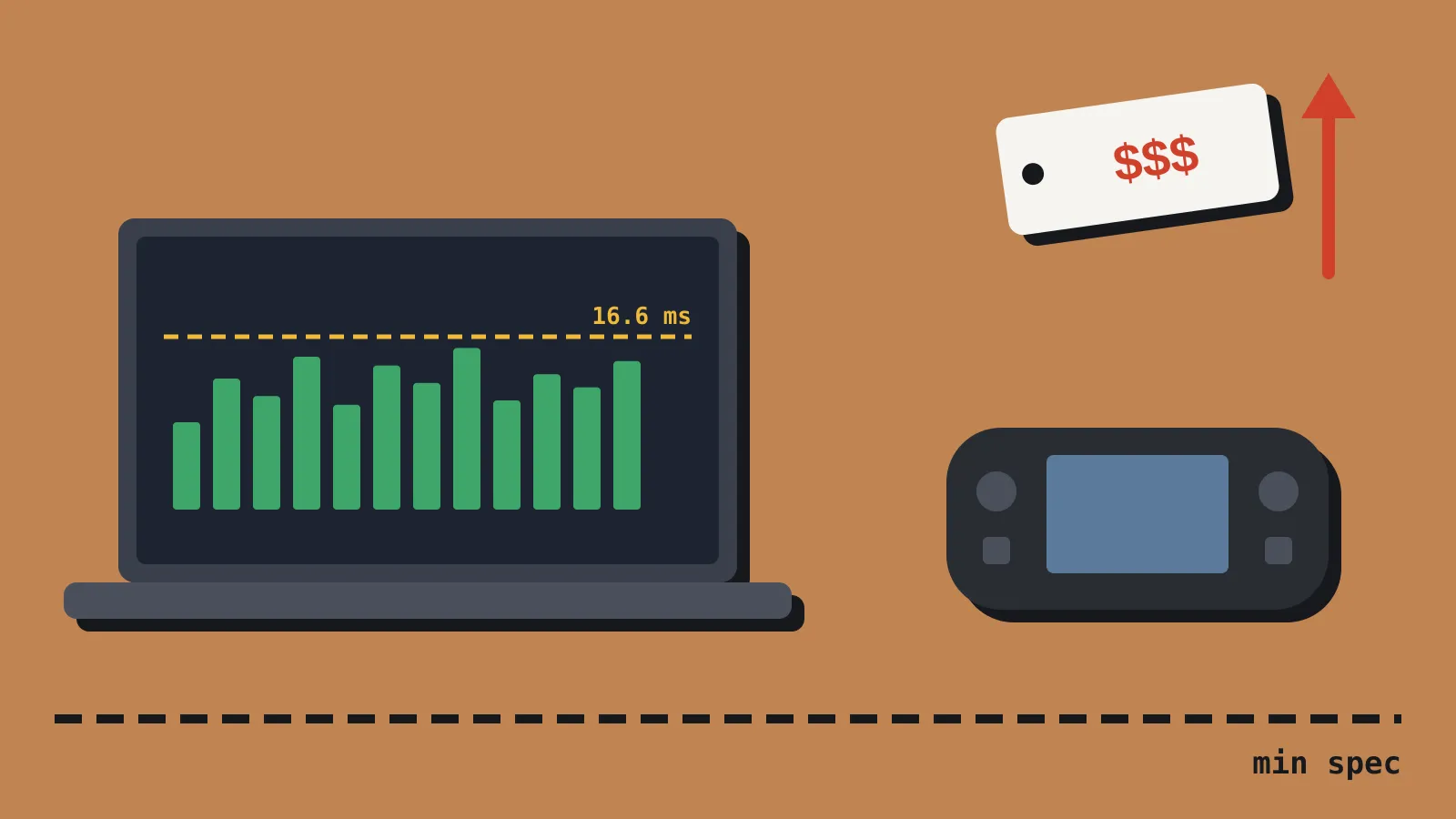
Console and graphics card prices have climbed so far that fewer people are buying new hardware, and analysts don’t expect relief until around 2028. In a GamesIndustry.biz opinion piece on 16 October, Rob Fahey argues this could lock players onto the machines they already own for years. The hardware already in people’s homes becomes the platform that matters most.
For a solo dev, that’s a planning signal. If you’re starting a game now, it will probably launch on the same PCs, consoles and phones your players own today. Set your minimum specs from those machines, test on one of them every week, and treat any performance headroom as a bonus.
What the numbers say
The clearest data comes from Circana, which tracks US retail sales. In a post on 9 October, Circana analyst Mat Piscatella said US Xbox hardware unit sales for January to August 2026 were down 33% on the same period last year, an all-time low. PlayStation units were down 25%, the lowest since 2013.
Prices explain much of it. According to Notebookcheck’s report of Circana’s figures, the average price paid for a PlayStation console this year was US$597, up 20%. That’s across all PlayStation models, not only the PS5. Xbox averaged US$529, up 26%. Both companies have raised prices more than once since 2025. Microsoft’s August rise took the cheapest Series S to US$499.99, and the company said memory and storage costs had risen more than two and a half times.
Memory is the root of it. Omdia’s analysis for Game Developer found PC memory prices nearly doubled in 2025. Micron, one of the biggest memory makers, said in June that supply would stay tight through 2027 and only improve gradually in 2028.
On the PC side, there are reports that Nvidia has stopped making the RTX 5090. Nvidia hasn’t confirmed this, so treat it as a rumour. Either way, the top end of the PC market is moving further out of reach for most players.
What players actually own
Steam’s hardware survey gives a better guide to your audience than any launch event. These are the September 2026 figures for Steam users.
| Spec | What the survey shows | What it means for you |
|---|---|---|
| System memory | 37.8% have 16 GB and 6.5% have 8 GB | Nearly half your players have 16 GB or less. Don’t make 32 GB your minimum. |
| Graphics memory | 26.7% have 8 GB, and 8 GB or less is still common | Keep your textures and effects workable in 8 GB or less. |
| Popular graphics cards | The RTX 3050, RTX 3060 and GTX 1650 are all still in the top 10 | Several years old and mid-range at best. Test on something like them. |
| CPU cores | 27.2% have 6 cores and 10.8% have 4 | Don’t assume eight fast cores for your simulation or streaming. |
| Screen resolution | 47.9% run 1920 x 1080 | 1080p is still the main target. Check your UI at that size. |
| Operating system | Windows 95.0%, Linux 3.1%, macOS 1.9% | Linux includes the Steam Deck, which is worth testing on. |
The survey is self-selecting and skews towards active Steam users, so treat it as a guide, not a census. It’s still far closer to your real audience than your development PC is.
Pick a floor device
A floor device is the weakest machine you promise your game will run on. Choose it early, write it down and test on it every week, not just before launch. Your development PC will hide problems that a four-year-old laptop shows straight away.
Good floor devices for a PC game in 2026:
- A laptop with an entry-level graphics card, such as an RTX 3050 or GTX 1650, with 16 GB of memory.
- A Steam Deck. It’s a fixed, well-known target with 16 GB of shared memory and a 1280 x 800 screen. Valve’s Deck Verified badge is also a useful sales signal.
- A PC with integrated graphics, if you’re making a 2D or low-poly game. Many laptops never get a dedicated card.
Then make the device part of your routine:
- Profile on it, not on your main PC. Use your engine’s built-in profiler first. Godot, Unity and Unreal all have one.
- Set budgets per scene. Pick a frame time (16.6 ms for 60 fps, or 33.3 ms for 30 fps) and a memory ceiling, and check each new level against them.
- Test at 1080p and below. Check that text is readable and menus fit.
- Put the floor device on your store page. List it as your minimum spec. Players trust specs that name real hardware.
Think about Macs and phones
Fahey expects phones and Apple silicon Macs to gain from the freeze, because people already own them and they’re relatively powerful. Whether that matters to you depends on your game.
Macs are a small slice of Steam, at 1.9% of users in September. If your engine exports to macOS easily, as Godot, Unity and Unreal do, a Mac build can still be worth it, but budget for testing and for Apple’s signing and notarisation steps. If it would mean a full port, look at your wishlist and community data first.
Phones are a bigger decision. Touch controls, short sessions and a different storefront often mean a different game. If your design fits, plan for it from the start rather than porting later. If it doesn’t, your time is better spent making the PC build run well on older machines.
What could change this
Prices may ease sooner if memory supply recovers faster than Micron expects. A new console generation would also reset expectations, but S&P Global Kagan’s July forecast assumes next-generation consoles at US$600 to US$800 by 2028. That’s unlikely to bring cheap hardware back quickly.
Should you care?
| You are | Our verdict |
|---|---|
| Starting a PC game now | Yes. Set your minimum spec from today’s Steam survey, and pick a floor device this month. |
| Close to launch | Test on a floor device now, and fix the worst scenes before you publish your requirements. |
| Making a 3D game with high-end visuals | Add lower quality settings that actually help on 8 GB graphics cards. Fewer players will upgrade. |
| Considering a Mac or phone version | Only if your engine and design make it cheap. Mac is under 2% of Steam, and phones usually need design changes. |
Sources
- A hardware market freeze could transform the industry forever (GamesIndustry.biz)
- Mat Piscatella on US hardware sales, 9 October (Bluesky)
- PlayStation sales fall to a 13-year low in the US (Notebookcheck)
- Microsoft increases Xbox prices worldwide (GameDev.net)
- How a surge in memory prices will affect the games industry (Game Developer)
- Micron says chip shortage will improve gradually in 2028 (GameDev.net)
- Console shipments expected to decline 19.5% in 2026 (GameDev.net)
- Steam Hardware and Software Survey (Valve)