RPG Maker U2U's free P2D map demo runs until 16 November
Gotcha Gotcha Games has put U2U's HD-2D style map editor on Steam for free, so you can judge it before committing your next RPG to it.
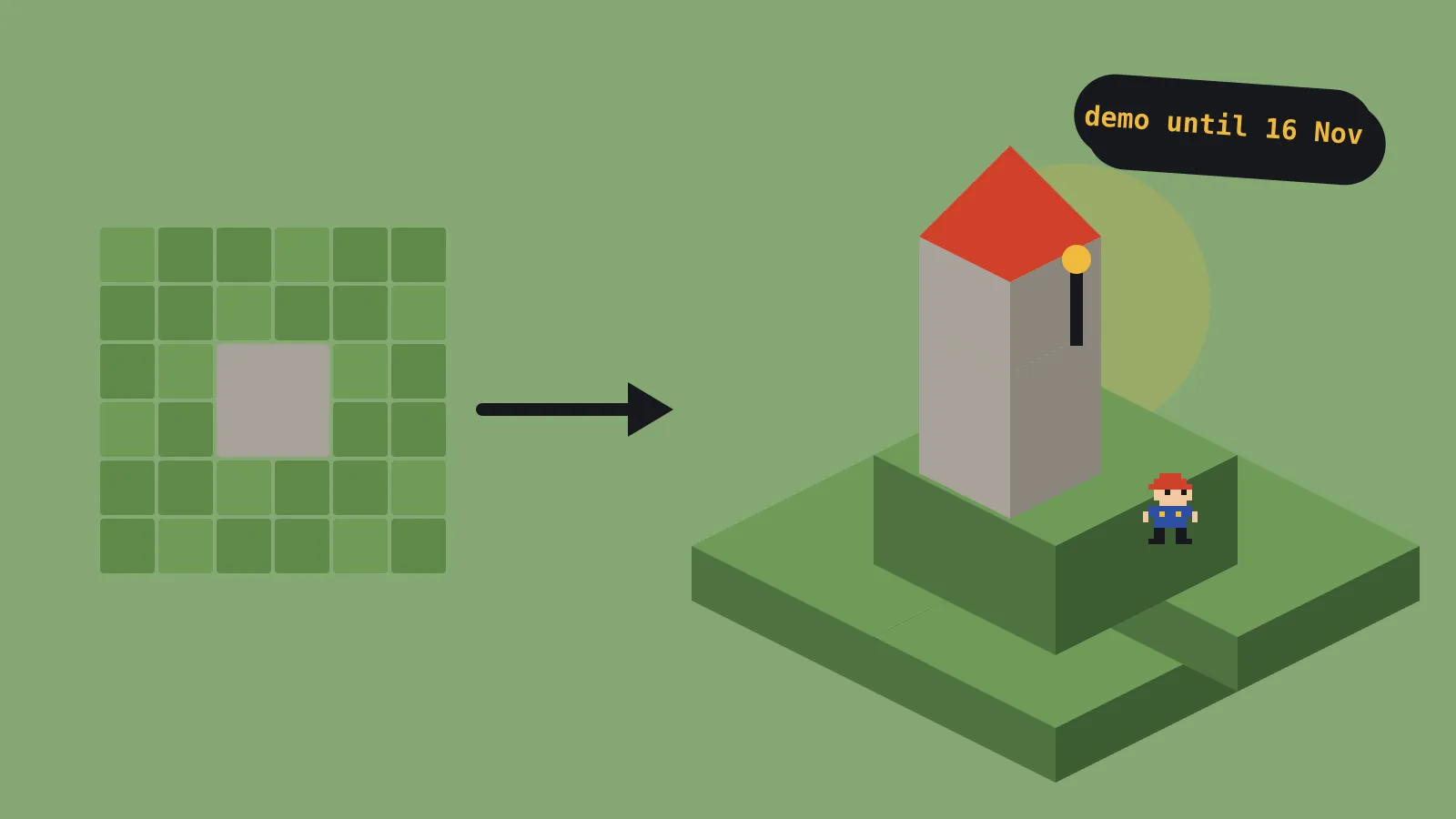
Gotcha Gotcha Games released a free P2D Map Editor demo for RPG Maker U2U on Steam on 20 October 2026, as part of Steam Next Fest. It stays up until 16 November. U2U is the next RPG Maker, announced in May. Its headline feature is P2D, short for Perspective 2D, which turns flat tile maps into layered scenes with height, depth and lighting. That is the look Square Enix made famous as HD-2D in Octopath Traveler. The demo covers map building only, with no game creation tools. There is still no price or release date for the full product.
What P2D does, and what it doesn’t
P2D takes standard 2D map tiles and stacks them as blocks in a 3D space. You get slopes, ledges, overpasses and buildings with several floors, all without opening a 3D modelling package. Height is set with a heightmap: black pushes ground down, white lifts it, and grey is the base level. On top of that sit effects such as depth of field, fog, rain, heat haze, water, cloud shadows and dynamic lights. Characters hidden behind walls show as silhouettes, which matters once your maps have real overhangs.
The editor gives you two ways to work. Quick creation lets you drop pre-made objects from a list onto the map. Detailed creation lets you build your own shapes from blocks, then dress them with ordinary map tiles. U2U ships with more than 100 finished P2D maps, plus characters, monsters, battle effects, music and sound effects.
The limits are just as clear. The camera is fixed. In the 80 Level interview, producer Hiroyuki Ichinose said free camera rotation was left out on purpose, so maps are built around one viewing angle. A Flat View option shows P2D maps in a flatter style, but it does not turn them into classic MZ top-down maps. The team also told 80 Level it won’t promise support for any particular genre beyond RPGs, though height and falling settings could allow some puzzle or action ideas.
What carries over from MZ and MV
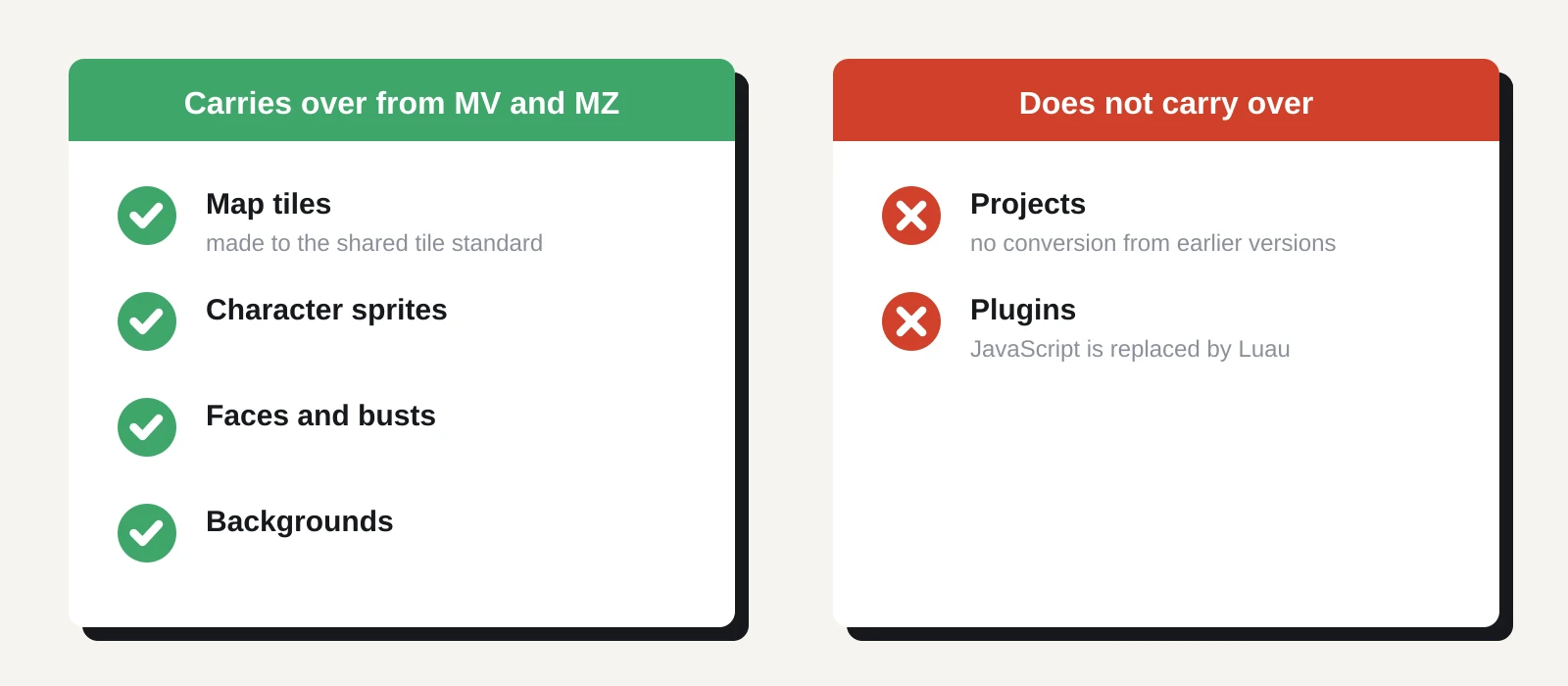
Your art mostly comes with you. Your projects and plugins don’t. The Steam page says U2U uses the same tile specifications as MV and MZ, and that 2D assets from those versions can be reused in P2D maps. Ichinose told 80 Level the same applies to custom tiles made to the standard, plus character sprites, face graphics, busts and backgrounds.
Project data is a different story. Gotcha Gotcha Games states on Steam that converting projects and plugins from earlier RPG Maker titles is not supported. Plugins are also changing language. U2U uses Luau, a scripting language derived from Lua, rather than the JavaScript that MV and MZ use. There will be runtime plugins that extend games and editor plugins that extend the tool. Every MZ plugin you rely on will need a U2U rewrite, by you or by its author.
The editor itself follows MZ closely. Events, the database and the general controls are modelled on it, so the learning curve for existing users should be short.
On the engine, early coverage from May reported U2U was built with Unity, the same base as RPG Maker Unite. In the 80 Level interview, Ichinose said it began as a Unity tool and was rebuilt as a standalone Steam app. You won’t need Unity, Unity Hub or a Unity ID. Whether the runtime still sits on Unity under the hood isn’t spelled out in current official material.
What it means for a solo dev or small team
If you are halfway through an MZ game, keep going. Nothing you have built will move across as a project, and your plugin stack would need replacing. Switching mid-production would cost you months for a new look.
If you are starting an RPG now, the choice is harder because so much is unknown. We don’t have a price, a release date or a list of export platforms. The Steam page lists Windows 11 64-bit as the minimum for the editor, with an Intel Core i3, 8 GB of RAM, a DirectX 11 graphics card and 10 GB of storage. That tells you what you need to make games, not which platforms your players can use. MZ, by contrast, exports today to Windows, Mac, web and mobile.
Licensing is also unsettled. The general Gotcha Gotcha Games terms allow individuals to sell games made with its products, with credit and copyright notices, and businesses need separate terms. U2U is listed among the products those terms cover, but we couldn’t find U2U-specific rules for its bundled assets. Don’t assume they match MZ’s until they are published.
A practical approach is to design your story, systems and battle balance in MZ now, using art that follows the shared tile standard. Your writing and art will survive a move later. Your event logic and plugins won’t, so keep heavy custom code to a minimum if you think you might switch.
What to do before 16 November
The demo is free and closes on 16 November, so it costs you an evening. Maps you save in it will carry over to the full release, according to the official press release. Here is what we’d test:
- Your own tiles. Import a tileset you made or bought for MZ and see how it looks as P2D blocks. Check the edges, shadows and how small details read at the fixed angle.
- Performance. Run the demo on the weakest PC you own. Load a busy pre-made map with fog, depth of field and lights turned on, and watch the frame rate.
- The fixed camera. Build a town with tall buildings and narrow lanes. Check whether silhouettes are enough for players to follow their character.
- Heightmaps. Make a cliff path with a few levels. See how long it takes to get walkable slopes right.
- Walking previews. Use the walking animation preview to see if character sprites feel grounded on raised terrain.
Gotcha Gotcha Games is also running a casual community event until 15 November. You post a screenshot of a demo map with the #P2Dmapevent tag on X or in the Steam Community Hub. There is no judging, but it is a cheap way to get feedback.
Then wishlist U2U on Steam if you are interested, so you hear about pricing and export details when they land. Until those details are public, treat U2U as promising but unproven for a commercial release.
Sources
- RPG MAKER U2U (Steam)
- Features (RPG Maker U2U official site)
- RPG Maker U2U P2D Map Editor Demo Now Available (Gotcha Gotcha Games press release via Gamespress)
- Product terms of use (Gotcha Gotcha Games)
- Interview: RPG Maker U2U lets you build HD-2D worlds without learning 3D (80 Level)
- RPG Maker U2U announced for PC (Gematsu)