Two years of texturing tools priced, from free to US$600
A free procedural tool and Adobe's paid painter both updated this month, so we priced a two-year solo project across five texturing options.
Material Maker 1.8 came out on 25 October 2026, per its Steam patch notes. It is free on itch.io and US$14.99 on Steam. Four days earlier, on 21 October, Adobe shipped Substance 3D Painter 12.2, which adds painted baking cages and a reworked Polygon Fill tool. For a solo dev, the pair raises a money question: how much does the paid tool still earn its fee?
What changed in each release
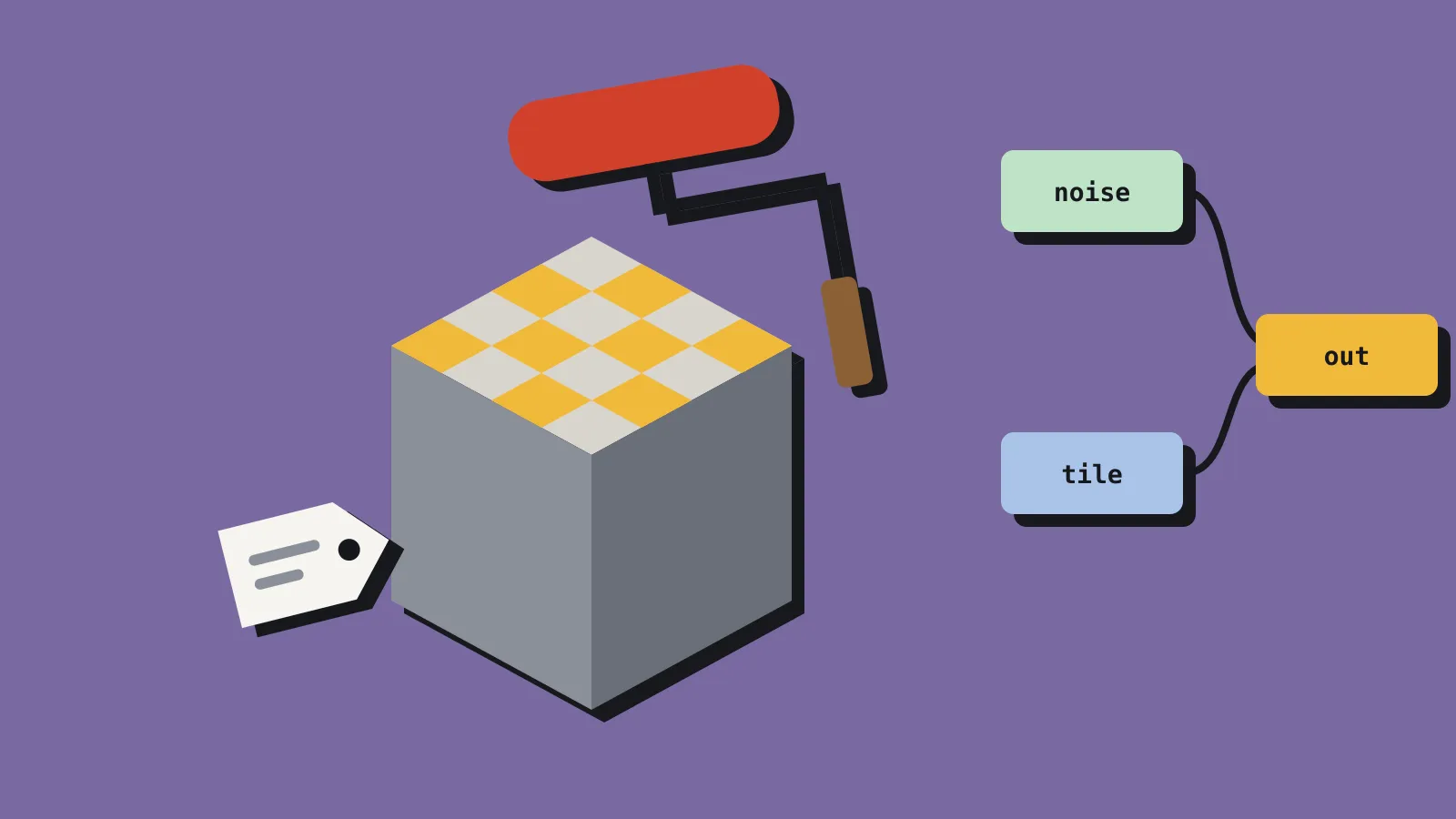
Material Maker is a node-based procedural material tool built on the Godot engine. You wire noise and shape nodes into a graph, and it outputs tileable texture maps. Version 1.8 moves it to Godot 4.7.2. It adds Auto Export, Crop and Trimsheet nodes, plus a higher quality Gaussian blur. Tiler and Splatter nodes now output each instance’s position, and spritesheet export gains an 8-line option. The notes credit most of the work to contributor williamchange and the wider community. It runs on Windows, macOS and Linux.
Painter 12.2 is aimed at people who bake detail from a high-poly sculpt onto a low-poly game mesh. A “cage” is the shell the baker projects from. Until now you set its offset globally. In 12.2 you can paint the offset per pixel, which fixes the usual skewed or missing detail around tight corners. Polygon Fill can now fill a whole loop of quads in one click, ignore hidden geometry by default and fill several channels at once. The viewport also gets optional order-independent transparency, switched off by default for performance. Adobe lists the bakers at 3.23.0 and the Substance engine at 9.6.1.
The tools a solo dev would actually compare
| Tool | Version (date) | Price | Best at |
|---|---|---|---|
| Substance 3D Painter | 12.2 (21 Oct 2026) | US$24.99/month, or US$199.99 on Steam | PBR painting and baking |
| Material Maker | 1.8 (25 Oct 2026) | Free on itch.io, US$14.99 on Steam | Procedural tileables, trim sheets |
| ArmorPaint | 1.0 (Sept 2026) | US$19 binaries, source free | Cheap Painter-style layer painting |
| Blender | 5.2 LTS (14 Jul 2026) | Free | Hand-painted textures, baking |
| Quixel Mixer | Final build (Feb 2026) | Free, no updates | Nothing new; avoid for fresh projects |
The Painter subscription price is Adobe’s Texturing plan, which Adobe raised to US$24.99 a month in March 2025, or US$249.88 a year prepaid. The plan covers Painter, Sampler and Designer. The Steam edition of Painter 2026 costs US$199.99 and gets feature updates until March 2027. After that you keep the version you have.
ArmorPaint reached 1.0 in September after eight years of early access, with its code rewritten in C, per Digital Production. Prebuilt binaries cost US$19 with no subscription. The source is under the zlib licence, so you can compile it yourself for free.
Blender 5.2 LTS came out on 14 July 2026 with support until July 2028. Texture painting barely moved, though. The only change listed is autosave in Texture Paint mode. Layered texture painting is planned but won’t arrive this year, according to Blender’s 2026 roadmap post.
Quixel Mixer is finished. Epic and Quixel released a final offline build in February and say no further updates are coming, as Digital Production reported.
What it means for a solo dev or small team
Over a two-year project, Painter costs US$499.76 on two prepaid annual Texturing plans. Paying monthly, it is US$599.76. The Steam route is US$199.99 for the 2026 edition. Adobe’s product manager told users in July that a 2027 Steam edition should follow in March, though he made no firm promise. If you buy that as well, the total lands near US$400. Material Maker costs nothing, or US$14.99 if you want Steam updates. ArmorPaint costs US$19 once. Blender is free.
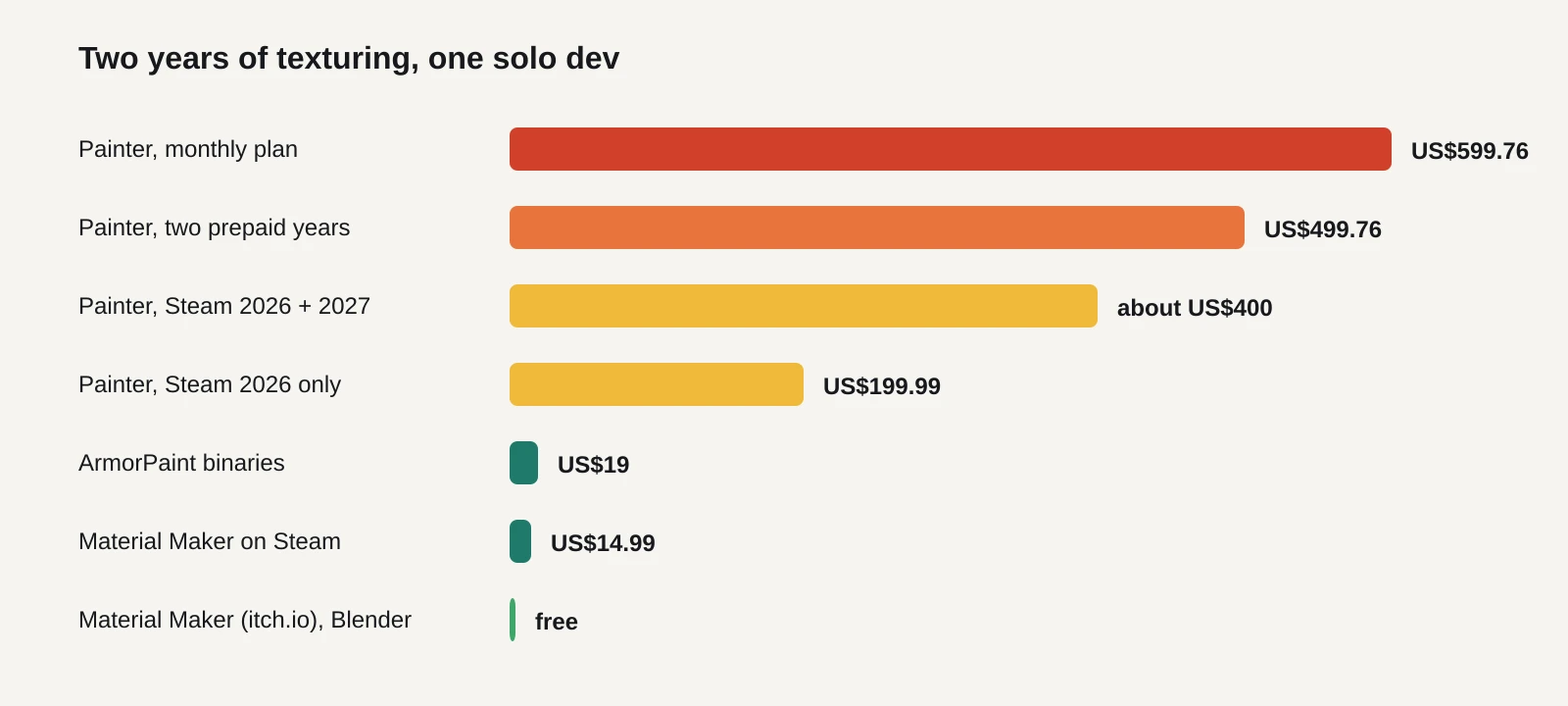
Style matters more than price. For stylised or low-poly games, Material Maker plus Blender covers most needs. Trim sheets, the new 1.8 node, are long strips of reusable detail that many meshes share. That suits small teams who can’t hand-texture every prop. Blender handles the hand-painted pass on hero assets.
For PBR realism with baked high-poly detail, Painter is still the reference. The 12.2 cage painting targets the baking errors that eat hours on hard-surface props. ArmorPaint is the closest cheap substitute for layer-based painting. It has no equivalent cage tool listed in its 1.0 notes, so expect more cleanup.
Engine export varies. Material Maker’s export docs list targets for Godot, Unity, Unreal Engine 4 and 5, and Blender. Painter ships default output templates for Unity HDRP and URP, Unreal and Blender. There is no Godot template, so Godot users pick the glTF metal-roughness preset or build their own. If you are on Unreal and already use Painter, our TexBridge piece covers a US$9 shortcut.
Licences are simple for the free tools. Material Maker’s code is MIT and its bundled assets are CC0, a public domain dedication, per the itch.io page. Adobe’s education plan bans commercial use, so students should not ship a game made on it.
Learning curve is the hidden cost. Material Maker asks you to think in node graphs, which takes a week or two if you have never used a shader editor. Painter and ArmorPaint feel closer to Photoshop layers. Blender’s texture painting is the least polished of the four.
What to do now
- If you rent Painter only for occasional props, price it against the US$199.99 Steam edition. Note that updates on that edition stop in March 2027.
- Before you buy the Steam edition for commercial work, check the current Steam licence terms yourself. The only staff answer we found dates from 2022.
- Download Material Maker 1.8 free from itch.io and build one trim sheet for your next level. If the Godot or Unity export works first time, you may not need a paid tool for environment textures.
- Try ArmorPaint’s US$19 build on one hero prop before you commit to a subscription.
- If any project still depends on Quixel Mixer, export your Mixer materials to plain texture maps now and plan to move off it.
- Godot users on Painter should test the glTF preset on a single asset and check normal map direction before batch exporting.
Our pick for a solo dev on a stylised game is Material Maker plus Blender, at no cost. For a realistic game with lots of baked hard-surface props, the Steam edition of Painter is the cheapest way into the paid tool.
Sources
- Material Maker on itch.io (RodZilla)
- Material Maker 1.8 patch notes (SteamDB)
- Material Maker on Steam (Steam)
- Exporting Materials (Material Maker docs)
- Substance 3D Painter 12.2 release notes (Adobe)
- Default output templates (Adobe)
- Substance 3D innovations and pricing updates (Adobe blog)
- Substance 3D Painter 2026 on Steam (Steam)
- Will the 2027 version of Painter have a perpetual licence on Steam (Adobe Community)
- ArmorPaint 1.0 swaps Haxe for C (Digital Production)
- Blender 5.2 LTS (Blender)
- Quixel Mixer dead, final offline version released (Digital Production)
- Material Maker 1.8 is out (CG Channel)
- Adobe releases Substance 3D Painter 12.2 (CG Channel)