European game unions want AI use labelled, so plan your disclosure
A manifesto from UK, Irish, Spanish and Italian game unions asks studios to avoid generative AI and label any use. Solo devs should get their records straight.
On 16 November 2026, the IWGB Game Workers’ Branch in the UK published On Generative AI Usage in the Games Industry, a manifesto written with Game Workers Unite Ireland, Spain’s CSVI and the FIOM-CGIL Milan Work Council. It asks employers to avoid generative AI where they can, to label any use they can’t avoid, and to stop training models on staff work without consent and pay. It has no legal force. It does set out what organised workers, and the players they are courting, will expect from the games you ship.
What the manifesto asks for
The document is aimed at four groups: workers, employers, players and regulators. Its scope covers AI used for player-facing assets (art, sound, code, dialogue) and for material that never ships, such as early concept art, reference boards and draft translations.
For employers, the asks are firm. Workers should decide when, where and how generative AI is used. Studios should not make anyone use it, and should ban it in their code of conduct, prototyping included. Where use is unavoidable, the studio should declare it precisely. Staff work should not become training data unless the person gives explicit consent, is paid fairly and can withdraw it later.
For regulators, the unions want a ban on adding anyone’s work to a training dataset without permission and fair pay. They also want datasets to say how data is used, stored and kept, with a right to withdraw at any time. They back the recommendations of a UK tech workers’ inquiry run by UTAW, another union.
For players, the ask is simple: support games made without generative AI, and say so publicly when you dislike its use.
The manifesto is less absolute than some headlines suggest. Its FAQ says a team can use generative AI if it decides together, after weighing cost, ethics, legal risk and the environment, as Kotaku reported. It does not mention the EU AI Act, and it says nothing specific about freelancers or solo developers.
Who is behind it, and how much weight it carries
The manifesto credits four groups by name. Kotaku and Inven Global list six unions, adding France’s STJV and Germany’s GDRT, which joined the others in a cross-border alliance after a summit in 2025. Kotaku says the document landed ahead of a second summit in Manchester.
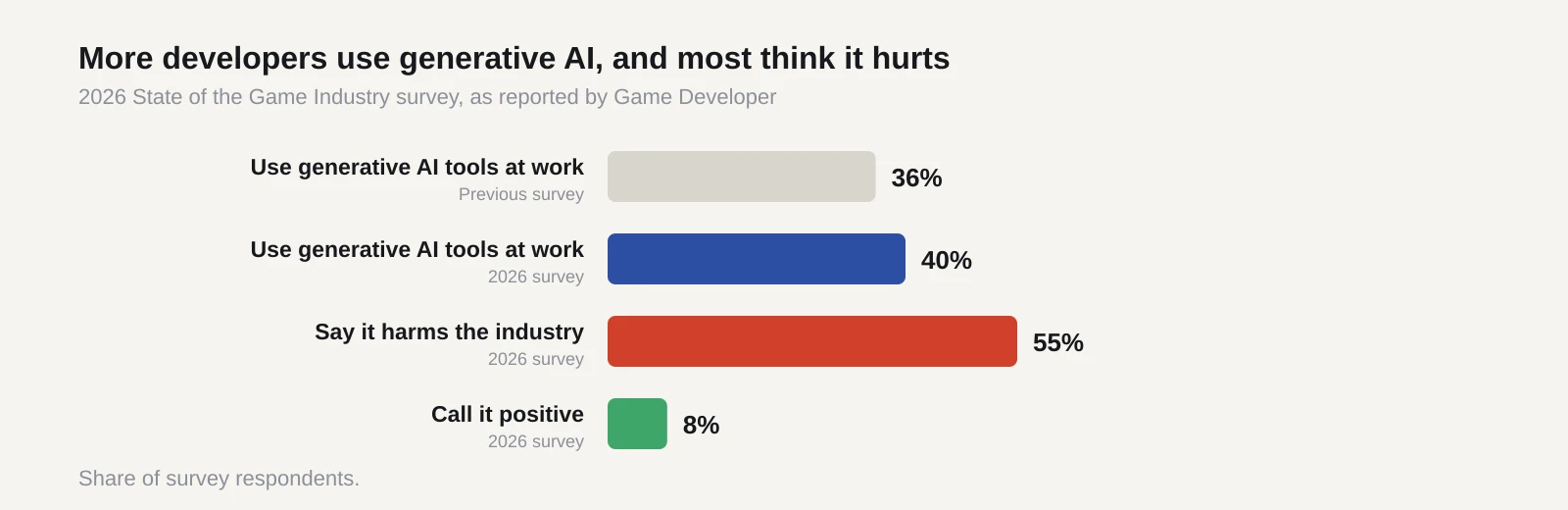
The timing matters because developer opinion has already turned. The 2026 State of the Game Industry survey, cited by Game Developer, found 40% of respondents use generative AI tools at work, up from 36%. Yet 55% said it harms the industry and only 8% called it positive.
The unions are not regulators. Nothing here binds a studio, a storefront or you. The pressure works through bargaining at larger studios and through player sentiment, and the second route reaches indies directly.
What it means for a solo dev or small team
You probably have no union, no HR policy and no works council. Most of the manifesto’s employer demands assume a boss and staff. Three parts still land on your desk.
First, disclosure. The unions want unavoidable use labelled, and they are telling players to favour games without it. Some festival jurors already think the same way, as we covered when some IGF jurors said they won’t vote for any AI use. Expect more players, press and curators to ask what you used, and to ask in more detail.
Second, freelancers. If you hire an artist, composer or translator, you are the employer in this picture. The consent and pay rules for training data apply to you in spirit, and a freelancer who has read this manifesto may ask for them in writing.
Third, the law, which is separate. The EU AI Act’s transparency rules in Article 50 have applied since 2 August 2026, according to Goodwin. Most duties fall on the companies that make AI tools, such as machine-readable marking of generated images, audio and text. Providers already on the market have until 2 December 2026 for that marking. Deployers must disclose deepfakes of real people, places or events, with a lighter duty for clearly fictional or artistic work. If your game runs a live AI chatbot or generated NPC dialogue, you may owe players a notice that they are talking to an AI. Get advice before you rely on our reading.
Steam is the duty most of you already face. Valve’s form, reworded in January 2026 per GamingOnLinux, covers AI content players see, in the game and on the store page. It says efficiency tools in your development setup are not its focus. The manifesto asks for more than that, since it counts concept art and reference material too.
What to do now
None of this needs a lawyer or a policy document. It needs a list and a few sentences you can stand behind.
- Keep a simple AI log. Note each tool, its version, what it made and whether that output ships. Include coding assistants, upscalers, voice tools and translation drafts.
- Read each tool’s terms for two things: whether it trains on your inputs, and what it says about ownership of outputs. Turn off training where you can and record that you did.
- Check your engine and asset licences too. Epic’s planned change to Unreal’s AI training terms is a good reason to write your own.
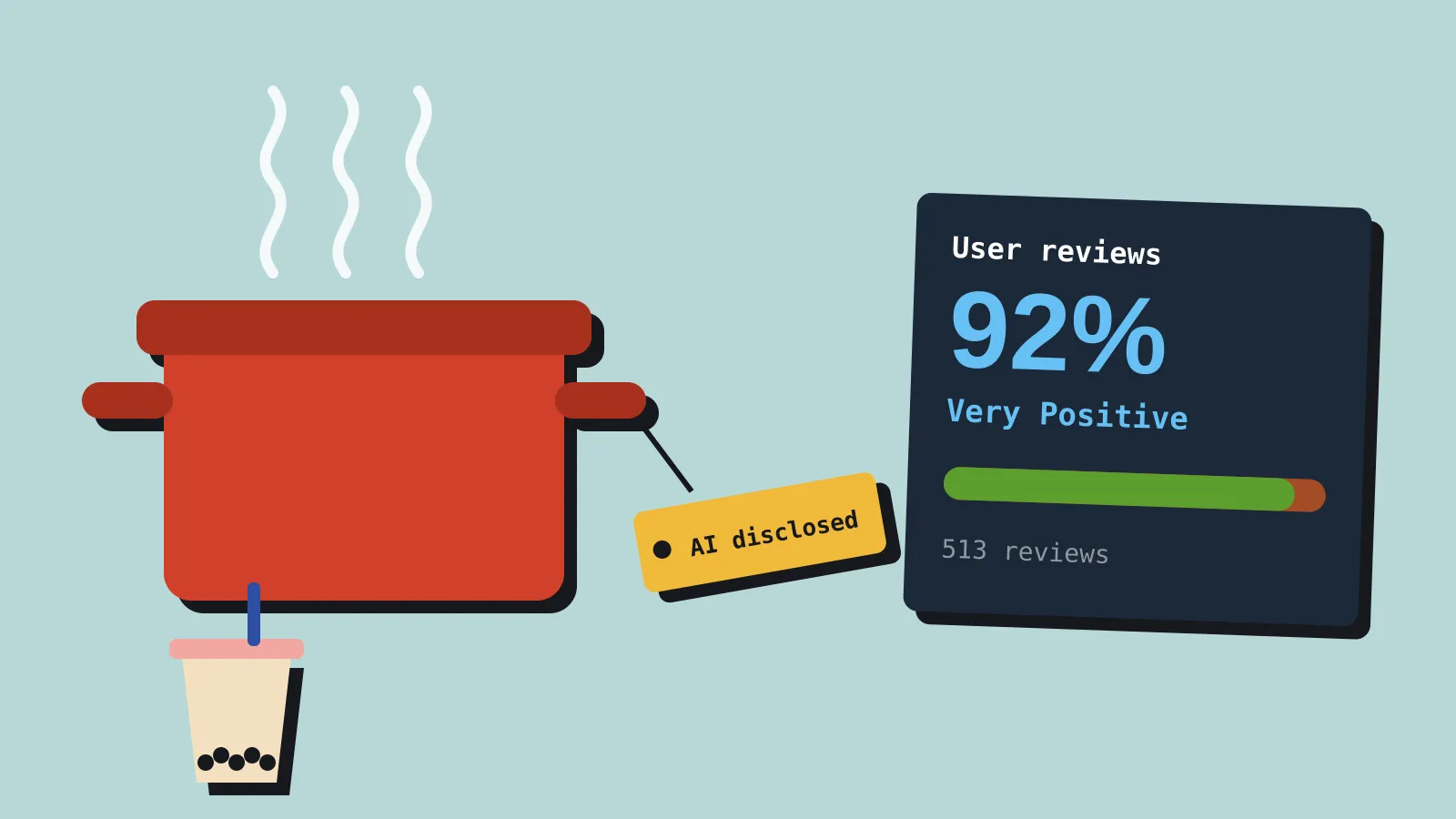
- Draft your Steam disclosure from the log, not from memory. Be specific about which assets and how they were changed by hand. Plain honesty has not sunk games before, as the Tasty Chef player reviews suggest.
- Add an AI clause to freelancer contracts. Say whether they may use generative tools, that they must tell you if they do, and that you won’t feed their work into a model without written consent and extra pay.
- Write a one-paragraph AI statement for your press kit and festival entries. Match it to your Steam text so nobody finds two versions.
- If you ship live AI features to EU players, add an in-game notice and ask your tool provider how its outputs are marked.
The unions’ stance is clear: they would rather you used none of it. Whether you agree is your call. Either way, the developers who can say exactly what they used will have the easiest time when someone asks.
Sources
- On Generative AI Usage in the Games Industry, IWGB Game Workers, source of the logo
- European Game Worker unions publish manifesto warning against unchecked AI usage, Game Developer
- Video game union manifesto calls on consumers to support games made without genAI, Kotaku
- European game unions publish joint manifesto against generative AI, Inven Global
- EU AI Act transparency obligations are now in force, Goodwin
- Valve tweak Steam AI disclosure form, GamingOnLinux