Korea's culture minister pick backed its loot box lawsuit law
Kang Yu-jung, nominated on 23 November, sponsored Korea's domestic agent and loot box damages laws. Here's what already binds foreign indie studios and what's still a proposal.

On 23 November 2026, South Korean President Lee Jae-myung nominated Kang Yu-jung as Minister of Culture, Sports and Tourism, Inven Global reports. Kang has been the senior presidential spokesperson since June 2025. Before that she was a lawmaker who sponsored several game bills, and two of them are now law. She still needs a National Assembly confirmation hearing. If you sell a game into Korea from overseas, the ministry she would run sets the rules for your store page.
What Kang put on the books
Inven lists four pieces of game legislation with her name on them. Their status varies a lot, so here they are one at a time.
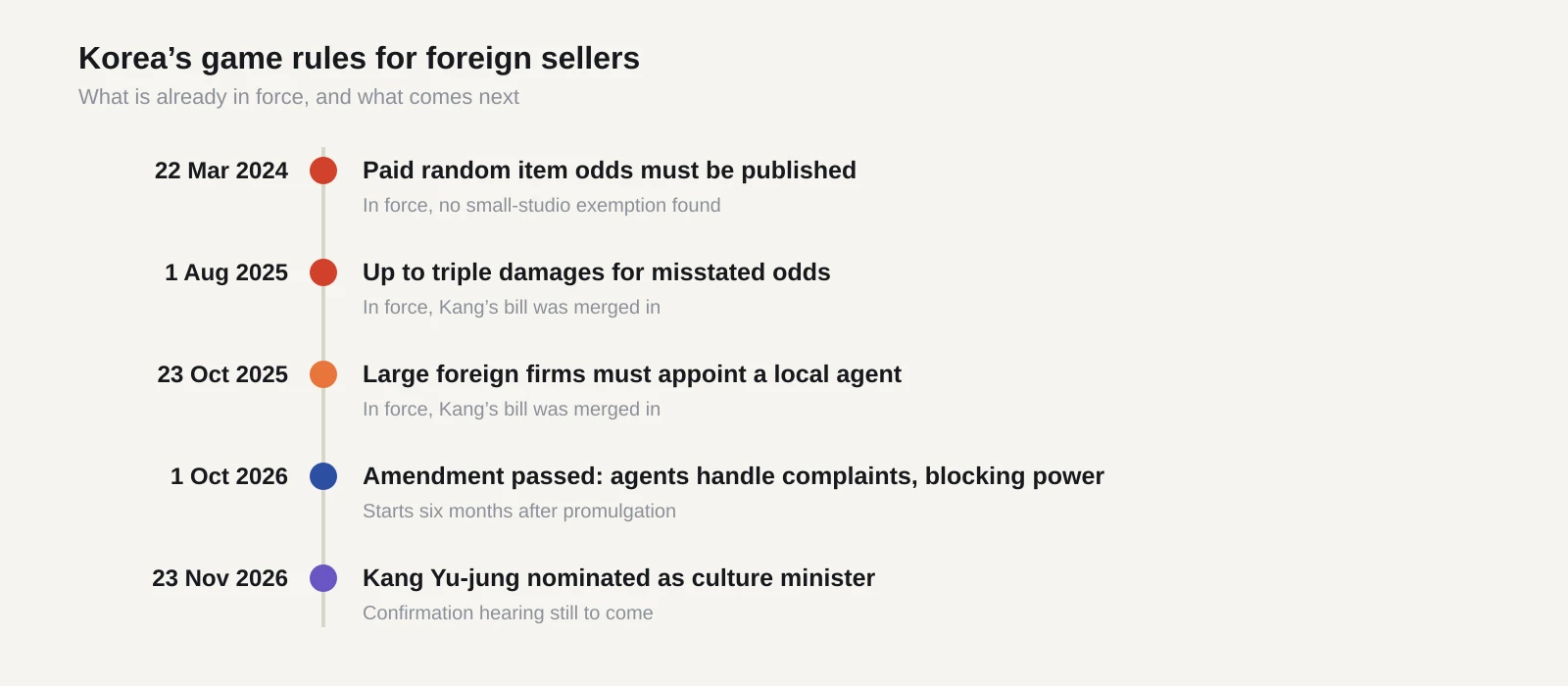
Domestic agents for foreign game companies (law, in force). Kang sponsored this on 3 June 2024, reviving a bill that had lapsed in the previous Assembly. It was merged into a committee bill and passed in September 2024. It took effect on 23 October 2025. The Korea Herald reported the final trigger: a foreign company with no Korean address must appoint a local representative if it has annual sales above 1 trillion won (about US$698 million), or a mobile game averaging 1,000 or more new Korean installs per day over the previous year. The ministry can also order a company to appoint one after an incident that seriously harms players. Failing to comply carries a fine of up to 20 million won.
Loot box damages lawsuits (law, in force). Kang sponsored a bill on 14 November 2024 to make it easier for players to sue over misrepresented drop rates. The Fact reports that her bill was one of three merged into an amendment passed on 31 December 2024. Per Asia Economy, it took effect on 1 August 2025. Courts can award up to three times the damages for intentional disclosure violations. The burden of proof also flips: the game provider must show it wasn’t at fault.
Esports standard contracts (status unclear). Her first bill, from 30 May 2024, offers funding to organisations that use standard contracts. It doesn’t force anyone to use them.
App store rankings (proposal). She proposed amending the Telecommunications Business Act so app stores would publish charts by weekly active users, next to the sales and download charts. Inven gives no sign it has passed.
The rules that already apply to everyone
The domestic agent rule only bites at scale. The loot box disclosure rule doesn’t.
Since 22 March 2024, anyone who makes, distributes or provides a game in Korea must publish the types of paid random items and their odds, both in the game and on a website, Asia Economy reported at launch. The rule covers items bought directly or indirectly with money where the outcome is random. Breaches can lead to a corrective order, then up to two years in prison or a 20 million won fine. The Chambers gaming law guide describes the duty as applying to all games, with limited exceptions. We couldn’t find a small studio or revenue exemption.
Age ratings matter too. Chambers says games distributed in Korea need a rating from the Game Rating and Administration Committee (GRAC) or a self-rating business before release, and it names Google and Apple as examples. Games rated 19+ must go to GRAC itself. Distributing without a rating can mean up to five years in prison or a fine.
What’s coming next
On 1 October 2026 the Assembly passed a follow-up amendment to the domestic agent law, BKL’s legal update explains. It takes effect six months after promulgation. Agents will also handle player complaints and damage claims. A company with a Korean subsidiary must appoint that entity. Fines extend to unqualified agents and to ignoring document requests.
The big new power is blocking. According to Yoon & Yang’s analysis, the ministry or GRAC can order networks to restrict a game if its publisher ignores corrective orders, including orders over probability disclosure. Kang didn’t sponsor this one. As minister, though, her ministry would enforce it.
What it means for a solo dev or small team
Short version: the domestic agent rule almost certainly doesn’t apply to you yet. A trillion won in sales, or an average of 1,000 new Korean mobile installs a day for a year, is far beyond most indie games. Inven reported that 81 companies were obligated as of 10 July, and 80 had complied.
The loot box rules are a different story. If your game sells random items for money and Korean players can buy them, you have a disclosure duty today. Players can also sue for up to three times their damages if you misstate odds on purpose. You’d have to prove you weren’t at fault. That’s tougher than the EU, where keeping loot boxes away from under-18s is still only a proposal.
The new blocking power is the real change for smaller studios. Today, the main penalties for a missed disclosure are corrective orders and fines. Once the amendment is live, ignoring a corrective order could get your game restricted in Korea. That’s a much bigger risk if Korea is a meaningful market for you.
The app store ranking idea is only a proposal. If it ever passes, weekly active user charts could help a well-retained indie game more than a big-budget launch spike. Treat it as something to watch alongside other mobile store rule changes.
None of this is legal advice. If Korea is a large share of your revenue, a local lawyer is worth the fee.
What to do now
Run through these checks before your next update ships:
- Audit your monetisation. List every paid item with a random outcome, including bundles where real money buys a currency that buys the random item. Publish the odds in the game and on a web page.
- Check your rating route. Chambers names Google and Apple as self-rating businesses, so their store rating questionnaires should cover Korea. On other storefronts, confirm whether a Korean rating is handled for you or whether you need to apply to GRAC.
- Think about Korean localisation. Asia Economy reported that GRAC has asked overseas platforms to block games only when they support Korean and contain content that wouldn’t pass review. Adding Korean makes you more visible to the regulator, so get your rating and disclosures right first.
- Track your Korean installs. If you’re on mobile, pull your daily new Korean installs from the store console. You’re probably far below 1,000 a day, but it’s cheap to know.
- Watch the promulgation date. The follow-up amendment’s six-month clock starts at promulgation. We’ll update this story when the date is published.
Sources
- Kang Yu-jung, sponsor of first Game Act bill, nominated as culture minister, Inven Global, source of the photo
- Advance legislation notice on criteria for foreign game companies to designate a domestic agent, Ministry of Culture, Sports and Tourism
- Culture Ministry passes decree to mandate that overseas game companies appoint domestic representatives, Korea Herald
- Legal update on the domestic agent amendment, BKL
- Yoon & Yang: domestic representative system shifts to substantive responsible entity, Inven Global
- Up to triple compensation for probability disclosure violations from August, Asia Economy
- Triple damages for misrepresented odds (Korean), The Fact
- Implementation of mandatory disclosure for probability-based items, Asia Economy
- GRAC block requests for Steam games, Asia Economy
- Gaming Law 2025: South Korea, Chambers and Partners