Charging for your game makes you a business, so plan for it
AssetHoard's blog argues a price tag gives your game a second job. Here's what that means in Steam fees, tax forms and weekly hours.

On 26 November 2026, AssetHoard’s blog published a piece arguing that your indie game turns into a business the moment you put a price on it. It’s a short, practical read, and it ends with a time budget you can try this week. Read the full article on AssetHoard’s blog before or after this. Below, we run through its main points and add the numbers and paperwork you’ll hit once real money starts moving.
What the article argues
The core claim is simple. Before a game has a price, it only has to please the person making it. After it has one, it also has to convince strangers to hand over money. The author calls this the game’s second job, and says most first-time devs plan for the first job and forget the second until launch week.
The piece frames this as a product problem rather than a game problem. People who make books, board games, apps and hardware all run into it: building the thing is roughly half the work, and finding buyers who trust you is the other half.
From there it makes a few practical arguments:
- Players are customers, and that’s fine. Taking them seriously means reading reviews properly, answering a support email, and fixing a bug even when it only hits a small slice of players. It also means deciding what your game won’t do, and saying so.
- Marketing is a skill you haven’t practised yet. Devs spend years on craft, then try outreach a fortnight before launch and get one reply from forty emails. The article puts that down to a lack of practice, and says the fix is more reps.
- Marketing and community belong on the roadmap. Trailer, store page, capsule art, devlogs, Discord, press and streamer lists, demos and festival entries get scheduled next to features, with the same weight.
- Admin is your job too. Business registration, tax and GST or VAT, publisher contracts, asset licences, code signing, refunds and bookkeeping. You can hand some of it to an accountant or lawyer, but you can’t ignore it.
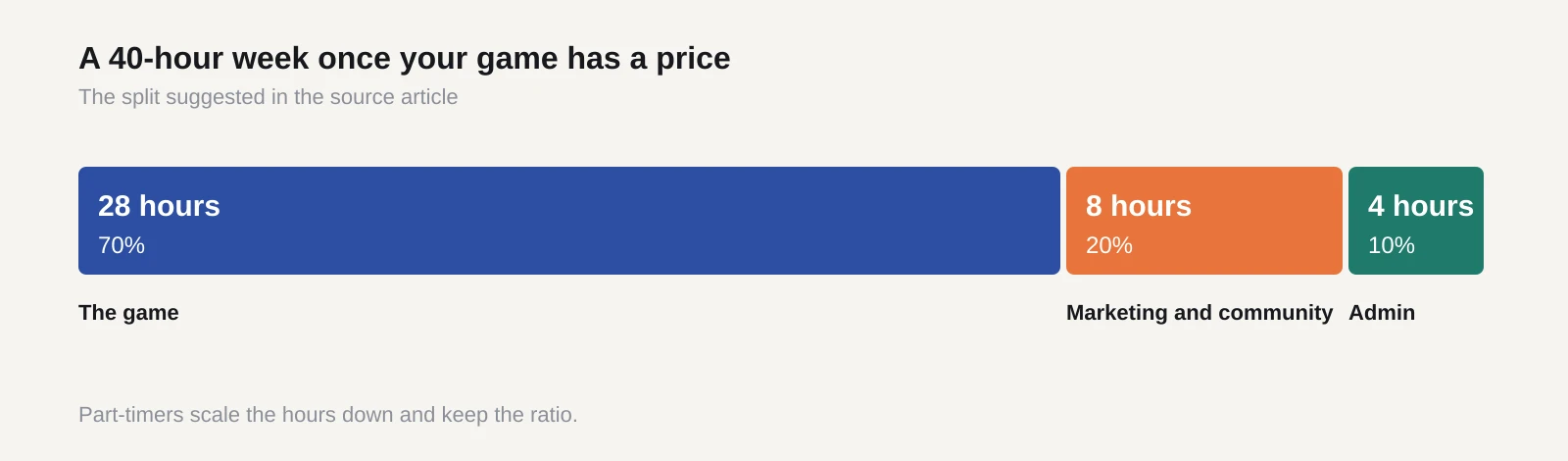
The most useful bit is a concrete time budget. For a solo dev on a 40-hour week, the article suggests roughly 70% on the game (about 28 hours), 20% on marketing and community (about 8) and 10% on operations and admin (about 4). Early on, that marketing slice might just be a devlog and a Discord server. Part-timers scale the hours down and keep the ratio.
The money maths behind the argument
The article stays mostly at the level of habits, so here are some figures that show why the business side bites.
Steam takes 30% of revenue until a game passes US$10 million, then 25%, then 20% above US$50 million, according to Game Developer’s coverage of the 2018 tier change. For almost every indie, the 30% rate is the one that applies. A US$15 game nets you about US$10.50 per sale before refunds, regional pricing and tax.
The Steam Direct fee is US$100 per game. You only get it back once the game reaches US$1,000 in adjusted gross revenue. That’s a low bar, but it’s still a bar, and plenty of releases never clear it.
Selling well also doesn’t guarantee the studio survives. We covered how Samson sold 150,000 copies and its studio still went bankrupt.
The marketing timeline matters too. If most of your sales land after launch month, then the 20% slice of your week has to keep running long after release day.
The paperwork, made specific
The article’s admin list is right but general. Here’s what a few of those items look like in practice.
Steam’s tax interview. Before Valve pays you, you complete a tax interview inside Steamworks. Valve’s tax FAQ says that if your country has no income tax treaty with the US, the IRS requires 30% withholding on your payments. If your country does have a treaty, you can claim a lower rate with a W-8BEN form and a tax identification number. Valve won’t refund amounts already withheld before you fix it, so do it before your first payout, not after.
Registering as a business. In Australia, the ATO says you must register for GST once your GST turnover hits A$75,000 (current or projected over 12 months), and you then have 21 days to do it. In the UK, GOV.UK says you need to register for Self Assessment as a sole trader once you earn more than £1,000 in a tax year, and VAT registration kicks in above £90,000 of taxable turnover. Other countries have their own versions, so check yours.
Publisher contracts. The article flags words like “exclusive” as things to understand before signing. If a publisher offer lands in your inbox, read our piece on publishing deal terms to watch first. An hour with a lawyer usually costs less than living with a bad clause for years.
Code signing. The article also lists signing your Windows builds, so players don’t see an unknown publisher warning when they run your installer. That matters most if you sell outside Steam, through itch.io or your own site.
What to do this week
You don’t need to fix everything at once. Here’s a short list based on the article’s advice and the numbers above.
- Block your hours. Try the 28/8/4 split for a month. Put marketing and admin time in your calendar as real blocks, not leftovers.
- Add a product lane to your roadmap. List store page, capsule art, trailer and your first devlog next to your feature tasks, with rough dates.
- Do the Steamworks tax interview early. If you’re outside the US, check whether your country has a treaty and get a tax ID sorted, since ITIN processing can take months.
- Check your local thresholds. Look up the sole trader and GST or VAT rules where you live, and note the turnover figure that would trigger registration.
- Start a simple ledger. A spreadsheet of income, expenses and receipts is enough at first, and it makes tax time much cheaper if you later hire an accountant.
- Write down what your game isn’t. One paragraph on scope gives you a ready answer for feature requests and reviews.
If you only read one more thing on this topic today, make it the full piece on AssetHoard’s blog. It covers the mindset side in more detail than we have room for here, and the 70/20/10 split is a handy starting point for a solo schedule.
Sources
- Your indie game is a business the moment you charge for it, AssetHoard’s blog, source of the cover image
- Steam Direct fee, Steamworks documentation
- Tax FAQ, Steamworks documentation
- Valve creates new rev-share tiers, Game Developer
- Registering for GST, Australian Taxation Office
- Set up as a sole trader, GOV.UK
- VAT registration, GOV.UK